
Concentrated sulfuric acid at 96% (w/w) is approximately 18.0 M. Using M = (10 × %w/w × density) ÷ molar mass, with density 1.836 g/mL and molar mass 98.08 g/mol: M = (10 × 96 × 1.836) ÷ 98.08 = 17.97 M. Use the calculator below to convert any concentration or plan a dilution.
Molarity & dilution calculator
Convert any % w/w reagent to molarity, then work out how much stock to dilute. Values are editable — defaults are typical 20 °C densities; use your reagent’s certificate of analysis for exact work.
Illustrative calculation from the standard relationship M = 10·(%w/w)·ρ ÷ Mw. Density varies with temperature and grade — verify against your reagent’s certificate of analysis and the applicable procedure.
The density of concentrated sulfuric acid is 1.8361 g/mL at 20 °C for 98% (w/w) acid, and the molar mass of H2SO4 is 98.079 g/mol.
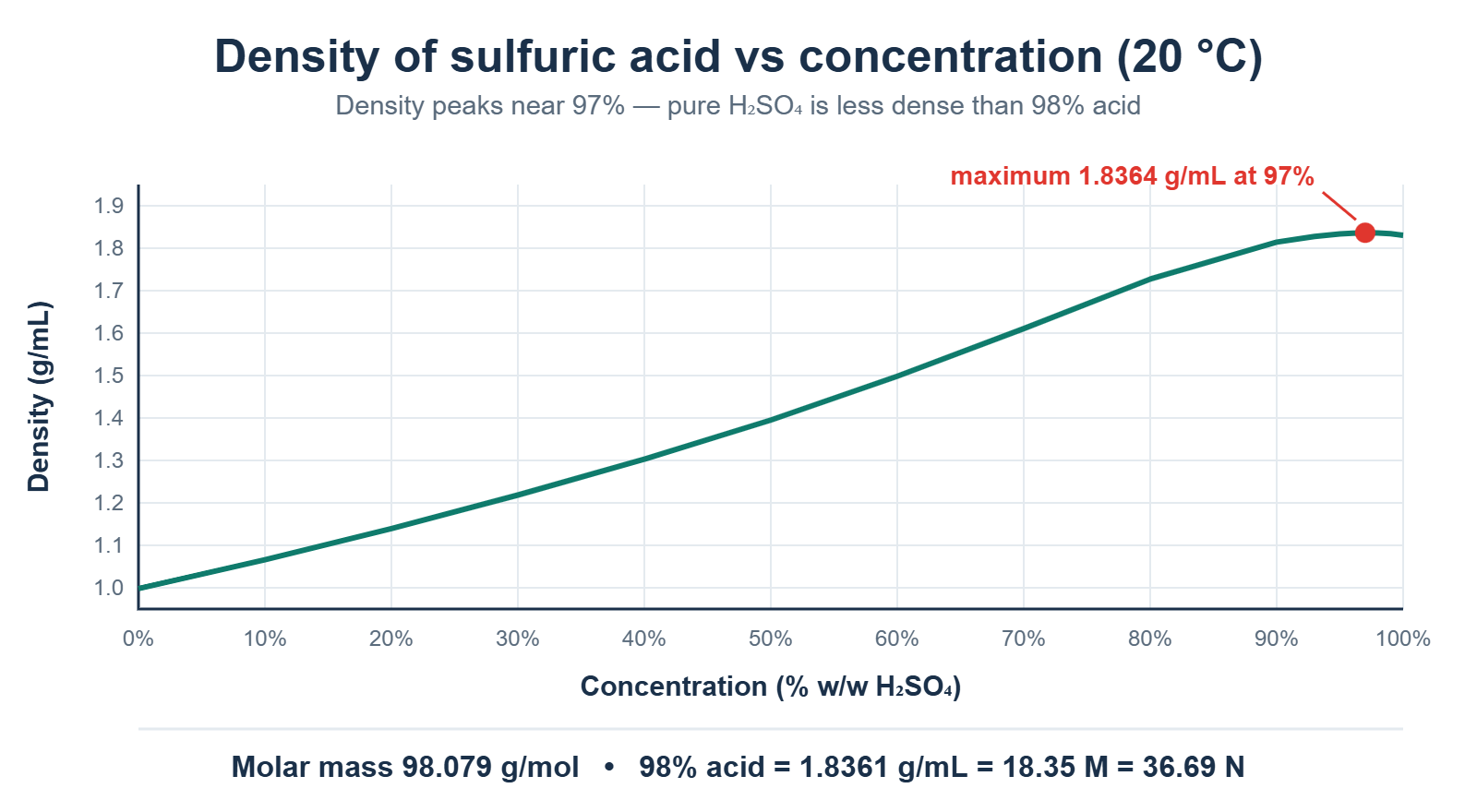
Those two numbers are rarely all you need. Sulfuric acid is sold at a range of strengths, its density changes sharply with concentration, and because it is diprotic its normality is twice its molarity. This page gives the full density table at 20 °C with molarity and normality worked out for each strength, then the dilution arithmetic and the handling sequence that keeps it safe. Table 1 breaks the molar mass down by element, and Figure 1 plots density against concentration.
Molar mass of H₂SO₄
| Element | Symbol | Atomic weight | Atoms | Contribution |
|---|---|---|---|---|
| Hydrogen | H | 1.008 | 2 | 2.016 |
| Sulfur | S | 32.06 | 1 | 32.06 |
| Oxygen | O | 15.999 | 4 | 63.996 |
| Total | 98.07 g/mol |
The value you will see quoted most often is 98.079 g/mol, which comes from the older standard atomic weights (S = 32.065). Current IUPAC weights give 98.072. The difference is immaterial for laboratory work — this page uses 98.079 throughout for consistency with standard reference tables.
Equivalent weight is 49.04 g/eq, because each molecule can donate two protons. That single fact drives most of the confusion covered further down.
Chromatography Troubleshooting Decision Engine
Any HPLC symptom, one starting point — the engine narrows hundreds of failure modes to the few that fit your evidence.
Density of sulfuric acid at 20 °C
Density rises steeply with concentration, then — counter-intuitively — peaks near 97% and falls again toward 100%. Pure anhydrous H2SO4 is less dense than 98% acid. If you are identifying an unlabelled bottle by density alone, that maximum makes the reading ambiguous above about 95%. Table 2 gives density, molarity and normality across the range.
| % w/w H₂SO₄ | Density (g/mL) | g H₂SO₄ per litre | Molarity (M) | Normality (N) |
|---|---|---|---|---|
| 10% | 1.0661 | 106.6 | 1.09 | 2.17 |
| 20% | 1.1394 | 227.9 | 2.32 | 4.65 |
| 30% | 1.2185 | 365.6 | 3.73 | 7.45 |
| 37% (battery acid) | 1.2769 | 472.5 | 4.82 | 9.63 |
| 40% | 1.3028 | 521.1 | 5.31 | 10.63 |
| 50% | 1.3951 | 697.5 | 7.11 | 14.22 |
| 60% | 1.4983 | 899.0 | 9.17 | 18.33 |
| 70% | 1.6105 | 1127.3 | 11.49 | 22.99 |
| 80% | 1.7272 | 1381.8 | 14.09 | 28.18 |
| 90% | 1.8144 | 1633.0 | 16.65 | 33.30 |
| 93% | 1.8279 | 1699.9 | 17.33 | 34.66 |
| 95% | 1.8337 | 1742.0 | 17.76 | 35.52 |
| 96% | 1.8355 | 1762.1 | 17.97 | 35.93 |
| 98% | 1.8361 | 1799.4 | 18.35 | 36.69 |
| 100% | 1.8305 | 1830.5 | 18.66 | 37.33 |
Densities at 20 °C. Molarity and normality calculated as ρ × 1000 × (% ÷ 100) ÷ 98.079.
Temperature matters. These are 20 °C values. Sulfuric acid density falls roughly 0.7–1.2% per 20 °C rise, so a hydrometer reading taken on a warm day will understate the true concentration unless you correct for it. For 100% acid the density drops from 1.8517 at 0 °C to 1.8305 at 20 °C and 1.8107 at 40 °C.
Converting any concentration yourself
Molarity (M) = density × 1000 × (% w/w ÷ 100) ÷ 98.079
Normality (N) = Molarity × 2
Worked example — 50% (w/w):
g per litre = 1.3951 × 1000 × 0.50 = 697.5 g
molarity    = 697.5 ÷ 98.079        = 7.11 M
normality   = 7.11 × 2               = 14.22 N
Why normality is double the molarity
H2SO4 has two replaceable protons, so its n-factor is 2:
H₂SO₄ → 2 H⁺ + SO₄²⁻
equivalent weight = 98.079 ÷ 2 = 49.04 g/eq
This is the single most common source of error in sulfuric acid calculations. A “1 N” solution is 0.5 M, not 1 M. If a method specifies normality and you prepare by molarity without halving, you will be twice as concentrated as intended.
Contrast this with sodium hydroxide, where one hydroxide per formula unit means normality and molarity are identical — see molar mass of NaOH for that case.
How much concentrated acid to dilute
Use C1V1 = C2V2. Volumes below are millilitres of concentrated stock needed per litre of final solution.
| Target | From 98% (18.35 M) | From 96% (17.97 M) | From 95% (17.76 M) |
|---|---|---|---|
| 1 M | 54.5 mL | 55.7 mL | 56.3 mL |
| 0.5 M (= 1 N) | 27.3 mL | 27.8 mL | 28.2 mL |
| 0.1 M | 5.5 mL | 5.6 mL | 5.6 mL |
| 0.1 N (= 0.05 M) | 2.7 mL | 2.8 mL | 2.8 mL |
Reagent-grade concentrated sulfuric acid is most often supplied as 95%, 96% or 98% (w/w). The three rows are highlighted in the table above, and the dilution volumes for each are in Table 3 — so you can work from whichever strength is printed on your bottle.
Handling: always acid to water
Diluting sulfuric acid releases a large amount of heat — enough to boil water locally and spatter concentrated acid out of the vessel.
- Add acid to water, never water to acid. Adding water to concentrated acid puts a low-density layer on top of a dense one; the heat is released at the interface and can flash the water to steam, ejecting acid.
- Add slowly, down a stirring rod or the vessel wall, with continuous stirring.
- Use a heat-tolerant vessel and consider an ice bath for large volumes or strong dilutions.
- Let it cool to room temperature before making up to the final mark. Warm solution contracts as it cools, so topping up while hot leaves you over-concentrated.
- PPE: splash goggles, acid-resistant gloves, lab coat; work in a fume hood for concentrated acid.
The mnemonic most people learn is “do as you oughta, add acid to water.”
A note on accuracy
Concentrated sulfuric acid is hygroscopic and absorbs water from the air, so an opened bottle drifts slightly weaker over time. Reagent-grade acid is also supplied as a range — “95–98%” is a common specification — which means the molarity of your particular bottle could sit anywhere between about 17.8 M and 18.4 M.
For routine dilutions that is fine. For titrimetry or anything reported as a quantitative result, standardise the diluted solution against a primary standard such as sodium carbonate or against standardised NaOH, rather than relying on the nominal concentration.
Frequently asked questions
What is the density of H₂SO₄?
1.8361 g/mL at 20 °C for 98% (w/w) concentrated acid. Dilute solutions are much less dense — 50% is 1.3951 g/mL and 10% is 1.0661 g/mL.
What is the molar mass of sulfuric acid?
98.079 g/mol (98.072 using current IUPAC atomic weights).
What is the molarity of concentrated sulfuric acid?
18.35 M for 98% (w/w) at 20 °C. For 96% it is 17.97 M and for 95% it is 17.76 M.
Why is 1 N sulfuric acid only 0.5 M?
Because H2SO4 donates two protons per molecule, so one mole provides two equivalents.
What is the equivalent weight of H₂SO₄?
49.04 g/eq — half the molar mass.
Is 100% sulfuric acid the densest?
No. Density peaks at about 97% (1.8364 g/mL) and decreases slightly toward 100% (1.8305 g/mL).
What is the density of battery acid?
Battery acid is typically 37% (w/w), giving 1.2769 g/mL at 20 °C and a molarity of 4.82 M.
The takeaway
Sulfuric acid’s molar mass is 98.079 g/mol and its concentrated density is 1.8361 g/mL at 20 °C, but the number that matters is whichever one matches the strength in your bottle — density varies from 1.07 to 1.84 g/mL across the usable range, and it peaks before 100%. Convert with ρ × 1000 × %/100 ÷ 98.079, remember that normality is double molarity because the acid is diprotic, add acid to water, and standardise anything you intend to report.
Sources
- IUPAC CIAAW — Abridged Standard Atomic Weights (2024) — H 1.0080, S 32.06 and O 15.999, giving M = 98.072; the 98.079 g/mol used throughout this page comes from the older weights (S = 32.065, O = 15.9994), as explained above g/mol
- St. Thomas — Density of sulfuric acid and sulfur trioxide, Steffen’s Chemistry Pages — 20 °C density table, 1–100% (w/w)
- Engineering ToolBox — Sulfuric acid density — independent cross-check of the density values
Density values were cross-checked against two independent sources and matched exactly at every overlapping concentration. Molarity and normality were then recomputed from those densities rather than copied, which is why a few values differ in the last digit from tables that round the grams-per-litre column first.