
Scientific Intelligence for Analytical Laboratories
Diagnose chromatography problems in minutes, not days. Structured decision engines that turn the symptom you can see into a ranked list of causes — every recommendation grounded in documented chromatographic evidence, with sources you can check. Free to use, no signup required.
Diagnostic engines, built from bench experience
Each tool walks you through a structured diagnostic interview and returns ranked root-cause hypotheses with corrective actions. Open, free, and public.
Chromatography Troubleshooting Decision Engine
Any HPLC symptom, one starting point. Describe what you’re seeing and the engine narrows hundreds of failure modes to the few that fit your evidence.
Run the engineHigh Backpressure Troubleshooter
Column pressure climbing or spiking? Isolate the blockage — frit, guard, tubing, or column bed — in under ten questions.
Diagnose backpressurePeak Tailing Troubleshooter
Tailing factor out of spec? Distinguish silanol effects, column overload, extra-column volume, and injection-solvent mismatch systematically.
Fix peak tailingLC-MS PK Peak Integrity Engine
Purpose-built for pharmacokinetic assays: interrogate carryover, matrix effects, ion suppression, and integration integrity before your data goes to QC.
Check peak integrityHow the AI diagnosis works
Not a chatbot guessing — a structured decision engine encoding real chromatographic reasoning.
Describe your symptom
Start from what the chromatogram shows: tailing, drift, ghost peaks, pressure, carryover, lost sensitivity.
Answer guided questions
The engine asks the same discriminating questions an expert would — when it started, what changed, what a blank shows.
Get ranked root causes
Receive hypotheses ordered by likelihood, each with concrete corrective actions and verification checks.
Start from your symptom
Jump straight to the guide or tool for the problem on your screen right now.
Latest from the Knowledge Hub
Practical troubleshooting guides written for working analytical chemists — each linked to the tool that solves it.
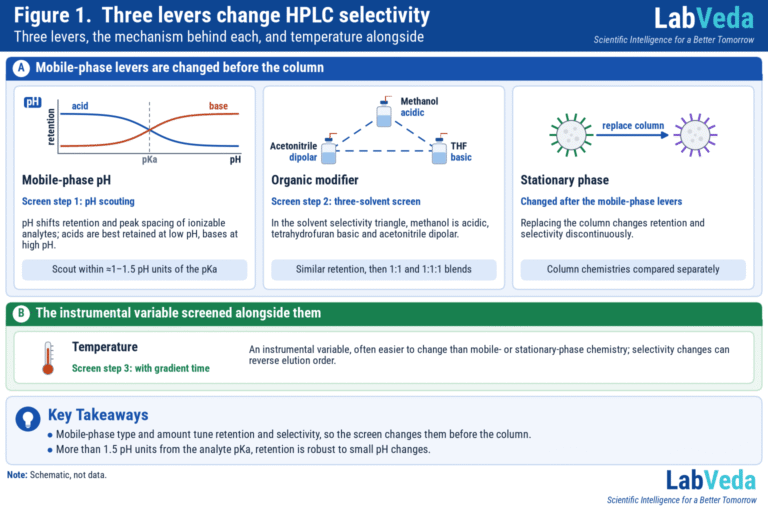
How to Optimize HPLC Selectivity: A Systematic pH, Solvent and Temperature Screen
To optimize HPLC selectivity, work through the levers in order and track the critical pair: scout mobile-phase pH against the analytes’ pKa…
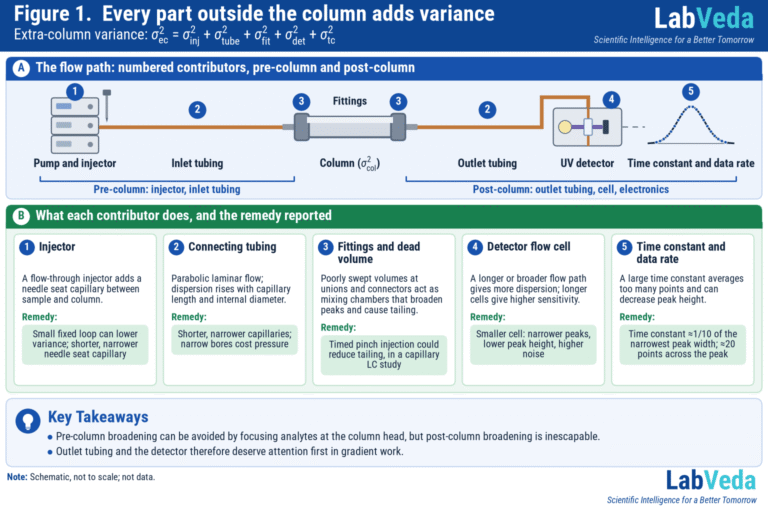
Extra-Column Dispersion: Where Efficiency Is Lost Outside the Column
Extra-column dispersion is the peak broadening that the injector, connecting tubing, fittings and detector add outside the column; their variances, not their…
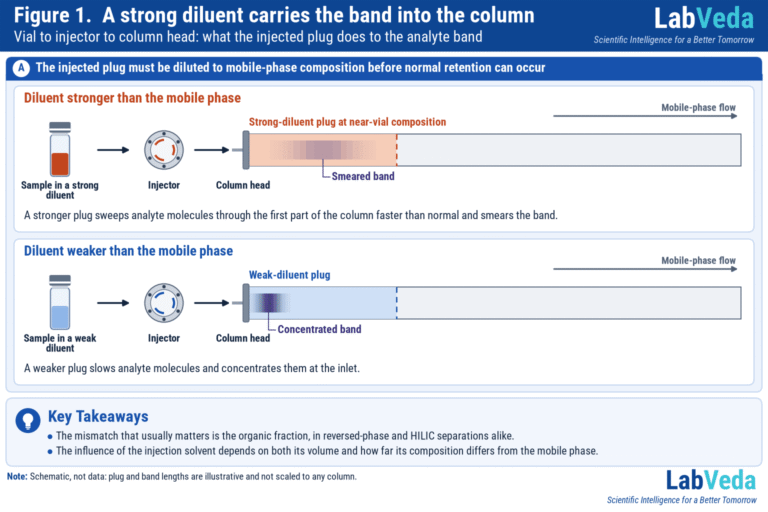
Injection Solvent Effects: How Diluent Strength and Injection Volume Distort Peaks
A sample diluent stronger than the mobile phase carries the analyte band through the column inlet inside the injected plug until that…
Free membership, built for your workflow
Every tool works without an account. Join free when you want your work to persist.
Free forever, no billing details. We ask what you work on so the tools can point you at the right answers.
Create free accountScientists helping scientists
LabVeda is a San Francisco–based Scientific Intelligence platform for analytical laboratories covering HPLC, UHPLC, and LC-MS. It brings together three things: diagnostic intelligence for troubleshooting and method development, a scientific knowledge engine of evidence-grounded guides, and a community built on a simple idea: scientists helping scientists.