
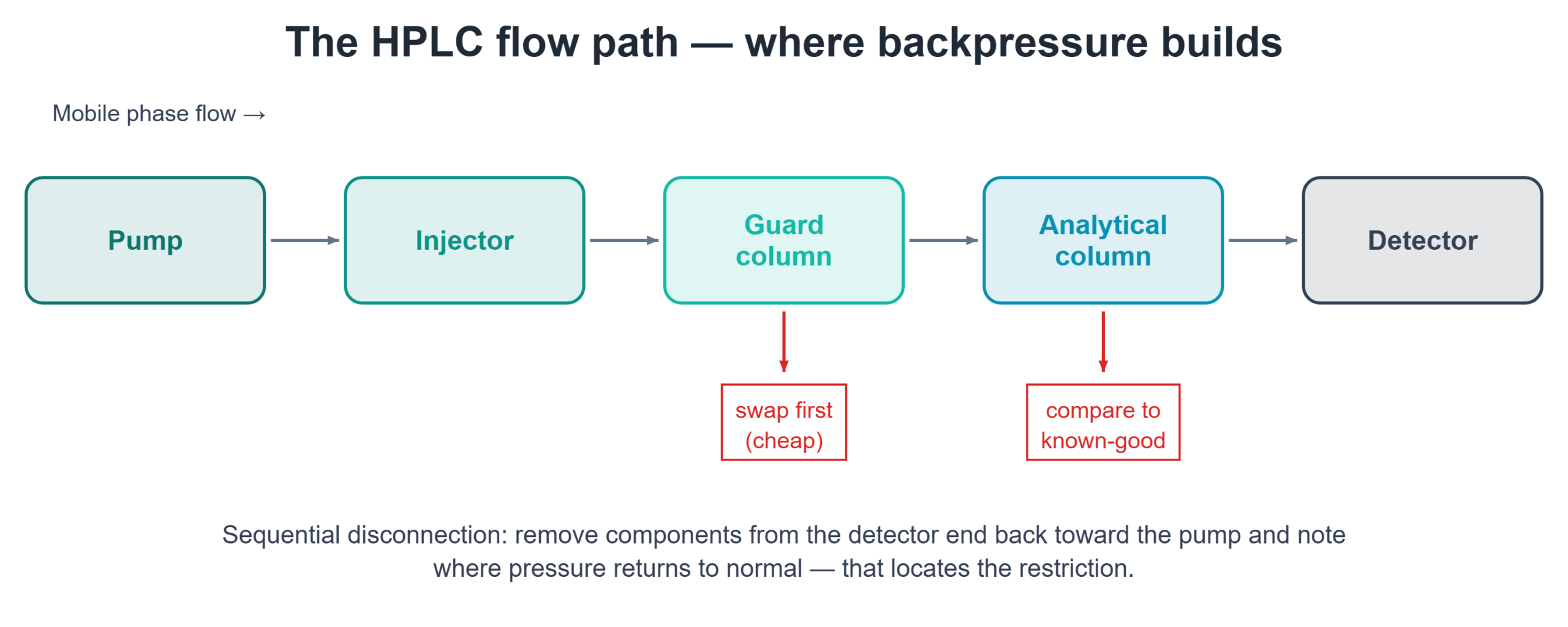
High system backpressure is one of the most common — and most disruptive — problems in liquid chromatography. Figure 1 shows the flow path you will be working along. It interrupts runs, triggers pump shutoffs, and at worst forces you to scrap a column mid-sequence. The frustrating part is that “high pressure” is a symptom, not a diagnosis. The same 600 bar reading can come from a clogged frit, a precipitated buffer, or simply the wrong column temperature.
This guide walks through the eight causes we see most often, in the order you should actually check them, so you can isolate the problem without swapping parts at random.
First, establish your baseline
Before troubleshooting, you need to know what “normal” looks like for your method. Record the typical operating pressure — the column back pressure — for your column, mobile phase, and flow rate when everything is working. A method running a 100 × 4.6 mm, 5 µm column at 1 mL/min with 50:50 methanol/water might sit comfortably around 100–150 bar. A sub-2 µm UHPLC column can legitimately run at 600+ bar by design.
Without a baseline, you can’t tell whether you’re looking at a genuine fault or normal behavior. If you don’t have one documented, this is the first thing to fix — log the pressure on every new method while it’s healthy.
High Backpressure Troubleshooter
Isolate the blockage — frit, guard, tubing, or column bed — before you start swapping parts.
The diagnostic principle: divide and isolate
The single most useful technique for backpressure is sequential disconnection. Because pressure is additive along the flow path, you can localize a restriction by removing components one at a time — starting from the detector end and working back toward the pump — and watching where the pressure drops back to normal. The component you remove that restores normal pressure is your culprit (or is immediately upstream of it).
Keep that principle in mind as you work through the eight causes below; nearly all of them can be confirmed with a targeted disconnection test rather than guesswork.
Cause 1: A clogged inlet frit or in-line filter
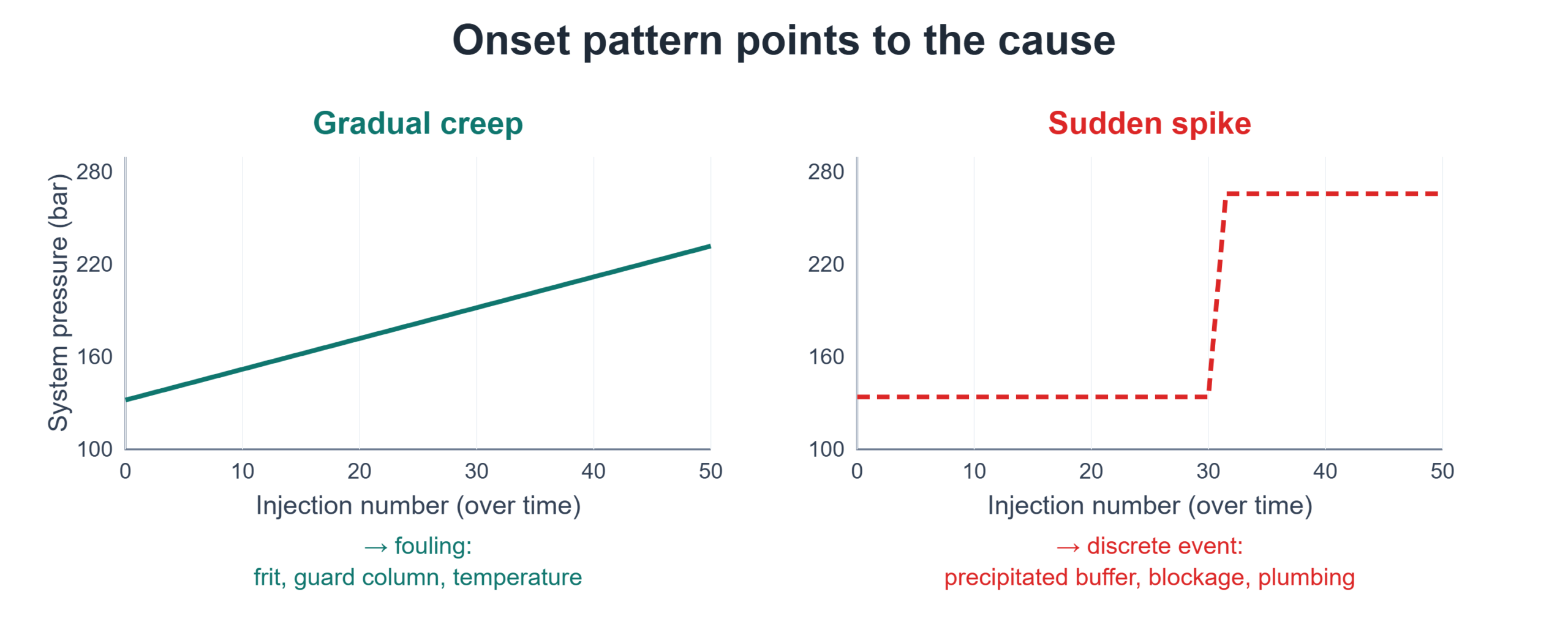
Figure 2 contrasts the two onset patterns. The inlet frit at the column head and any in-line filter are designed to trap particulates — which means they are the first place particulates accumulate. A partially blocked frit raises pressure steadily over many injections. If pressure has crept up gradually rather than jumping suddenly, a fouled frit or filter is the leading suspect.
Confirm it by disconnecting the column and checking system pressure with a union in its place; if the pressure returns to normal, the restriction is in or at the column. Replacing an in-line filter frit is cheap and often fully resolves the problem.
Cause 2: The guard column
Guard columns exist to take the abuse so your analytical column doesn’t. When they do their job, they clog. A guard column that has quietly accumulated matrix and particulates will raise backpressure exactly the way a fouled frit does. If you run a guard, it should be near the top of your suspect list — and replacing it is far cheaper than replacing the analytical column it protects.
Cause 3: Precipitated buffer
This is the classic sudden-onset cause. Phosphate and other buffers have limited solubility in high-organic mobile phases; when a gradient pushes organic content high, or when a buffered aqueous line meets a high-acetonitrile line, salt can precipitate inside tubing, the column, or the pump heads. Backpressure spikes, sometimes dramatically, and the damage can be permanent if crystals score a piston seal.
The tell is a sudden pressure rise associated with a method using buffer at high organic. Prevention beats cure: keep buffer concentrations modest, verify solubility across your full gradient range, and always flush buffer out of the system with an intermediate wash before storing in high organic.
Cause 4: Column blockage or void
Particulates, precipitated sample, or strongly retained matrix can accumulate on the column head and form a physical blockage, raising pressure. To separate a blocked column from an upstream frit or filter issue, compare the column’s pressure against a known-good column of the same type run under identical conditions. A blocked column often also shows peak shape degradation alongside the pressure rise, which helps separate it from a purely upstream restriction.
Cause 5: Wrong (or drifting) column temperature
Mobile phase viscosity falls as temperature rises, and pressure scales with viscosity. A column oven that is set too low, has failed, or wasn’t given time to equilibrate will run at higher pressure than the same method at the correct temperature. If your pressure is high but nothing is physically clogged, check that the oven is on, at setpoint, and equilibrated — especially first thing in the morning or after a method change.
Cause 6: Tubing and fittings
Connecting tubing that is too narrow, too long, or kinked adds restriction. Over-tightened or mismatched fittings can crush tubing or intrude into the flow path. This cause is easy to introduce accidentally during maintenance — a swapped line, a wrong ferrule — so if pressure jumped right after you worked on the system, suspect the plumbing you just touched.
Cause 7: The wrong mobile phase or flow rate
It sounds obvious, but a surprising number of “high pressure” calls trace to a method running at the wrong composition or flow. A mostly-aqueous mobile phase is far more viscous than a high-organic one; a flow rate entered a decimal place off will pin the pressure. Before disassembling anything, confirm the method is actually running the composition and flow you think it is.
Cause 8: Pump and system faults
Finally, the pump itself. A failing check valve, a worn piston seal, or a partially blocked pump head can produce erratic or elevated pressure, often with pressure ripple or instability rather than a clean high reading. If disconnection tests exonerate the column, guard, and plumbing, and the pressure trace looks noisy or pulsing, the fault is likely in the pump.
Putting it together
- Check the baseline — is this actually abnormal for the method?
- Note the onset — gradual (frit, guard, temperature) vs. sudden (precipitation, plumbing, blockage).
- Disconnect sequentially from the detector back to localize the restriction.
- Swap the cheap, likely parts first — in-line filter, guard column.
- Rule out the simple causes — temperature, composition, flow — before touching the pump.
- If everything downstream is clean and pressure is erratic, investigate the pump.
The takeaway
High backpressure is a localization problem, not a parts-swapping problem. The onset pattern tells you whether you’re chasing gradual fouling or a sudden event, and sequential disconnection tells you where along the flow path the restriction lives. Work from those two clues and you’ll fix the actual cause instead of replacing good hardware.
Related troubleshooting guides: Why your HPLC peaks are tailing and HPLC baseline noise and drift.
For a guided, step-by-step diagnosis of your specific pressure problem, try the LabVeda High Backpressure Troubleshooter.