
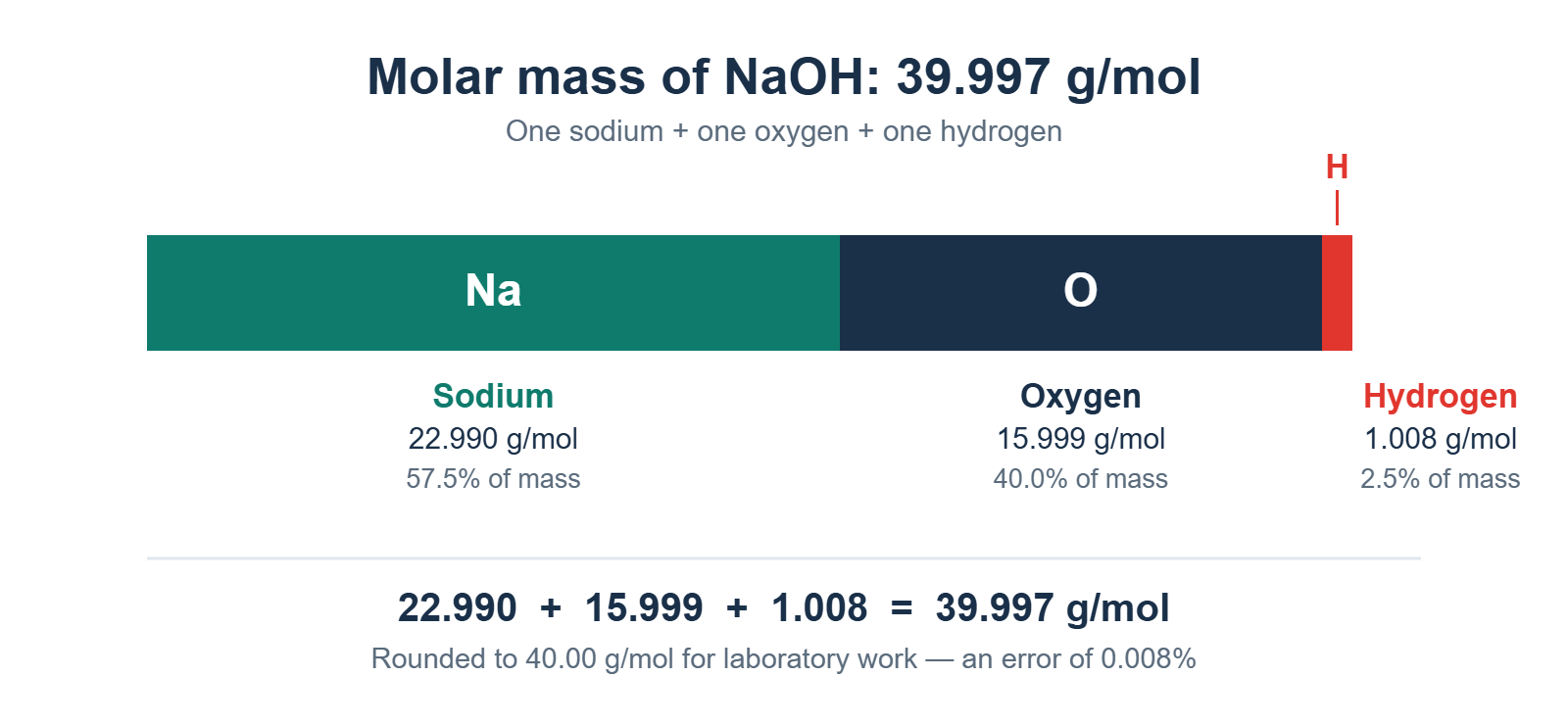
The molar mass of NaOH is 39.997 g/mol, almost always rounded to 40.00 g/mol for laboratory work.
That convenient round number is why sodium hydroxide shows up in so many first-year problem sets: one mole is 40 g, so a 1 M solution is 40 g in a litre and the arithmetic stays in your head. This page gives you the value, the calculation behind it, the conversions you actually need at the bench, and the one practical caveat that catches people out when accuracy matters.
The value, in every form you might need it
“Molar mass”, “molecular weight”, “formula weight” and “gram molecular mass” all refer to the same quantity here, and you will see NaOH written with any of them. Table 1 gives the value in each form.
| Quantity | Value |
|---|---|
| Molar mass | 39.997 g/mol |
| Working value used in labs | 40.00 g/mol |
| Formula weight (FW) | 39.997 |
| Relative formula mass (Mr) | 39.997 (dimensionless) |
| Equivalent weight | 39.997 g/eq |
| In atomic mass units | 39.997 u |
Strictly, NaOH is an ionic compound rather than a molecule, so “formula mass” is the more correct term than “molecular mass” — but in practice the terms are used interchangeably and refer to the same 40.
Chromatography Troubleshooting Decision Engine
Any HPLC symptom, one starting point — the engine narrows hundreds of failure modes to the few that fit your evidence.
How the number is calculated
Add the standard atomic weight of each element in the formula. NaOH contains one sodium, one oxygen and one hydrogen; Table 2 shows each contribution, and Figure 1 shows the same split by mass.
| Element | Symbol | Atomic weight | Atoms | Contribution |
|---|---|---|---|---|
| Sodium | Na | 22.990 | 1 | 22.990 |
| Oxygen | O | 15.999 | 1 | 15.999 |
| Hydrogen | H | 1.008 | 1 | 1.008 |
| Total | 39.997 g/mol |
Using IUPAC standard atomic weights, Na = 22.990, O = 15.999 and H = 1.008, giving 39.997 g/mol. Rounding to 40.00 introduces an error of about 0.008% — utterly negligible next to the weighing and purity errors discussed further down.
Converting grams to moles (and back)
Two formulas cover almost everything, with worked conversions in Table 3:
moles = mass (g) ÷ 40.00
mass (g) = moles × 40.00
| Mass of NaOH | Moles |
|---|---|
| 1 g | 0.0250 mol |
| 5 g | 0.1250 mol |
| 10 g | 0.2500 mol |
| 17.6 g | 0.4400 mol |
| 20 g | 0.5000 mol |
| 40 g | 1.0000 mol |
| 100 g | 2.5000 mol |
Worked example. How many moles are in 17.6 g of NaOH?
moles = 17.6 g ÷ 40.00 g/mol = 0.440 mol
In reverse. How many grams give 0.75 mol?
mass = 0.75 mol × 40.00 g/mol = 30.0 g
How much to weigh for a given molarity
Molarity is moles per litre, so the mass you need is simply molarity × volume in litres × 40.00. Table 4 lists the common cases.
mass (g) = molarity (mol/L) × volume (L) × 40.00
| Target concentration | Per 100 mL | Per 250 mL | Per 500 mL | Per 1 L |
|---|---|---|---|---|
| 0.1 M | 0.40 g | 1.00 g | 2.00 g | 4.00 g |
| 0.25 M | 1.00 g | 2.50 g | 5.00 g | 10.00 g |
| 0.5 M | 2.00 g | 5.00 g | 10.00 g | 20.00 g |
| 1 M | 4.00 g | 10.00 g | 20.00 g | 40.00 g |
| 2 M | 8.00 g | 20.00 g | 40.00 g | 80.00 g |
| 4 M | 16.00 g | 40.00 g | 80.00 g | 160.00 g |
For a full step-by-step method including the safety sequence, see our guide to preparing 0.25 M sodium hydroxide solution.
Percentage strength to molarity
A % w/v figure is grams per 100 mL, so multiply by 10 to get grams per litre, then divide by 40.00. Table 5 gives the conversions.
| Strength (% w/v) | g per litre | Molarity |
|---|---|---|
| 0.2% | 2 g | 0.05 M |
| 2% | 20 g | 0.50 M |
| 4% | 40 g | 1.00 M |
| 10% | 100 g | 2.50 M |
| 20% | 200 g | 5.00 M |
Note that % w/w is a different quantity and needs the solution density to convert. Concentrated 50% (w/w) NaOH, for instance, works out at roughly 18.9 M — the full calculation is in our article on the molarity of 50% (w/w) sodium hydroxide.
Equivalent weight and normality
NaOH releases one hydroxide ion per formula unit, so its n-factor is 1 and:
equivalent weight = molar mass ÷ 1 = 39.997 g/eq
The practical consequence is that for sodium hydroxide, normality and molarity are numerically identical. A 1 N NaOH solution is a 1 M solution; 0.1 N is 0.1 M. This is not true for polyprotic reagents — sulfuric acid, with two replaceable protons, has an equivalent weight of half its molar mass, so 1 M H2SO4 is 2 N.
The caveat that matters at the bench
Here is where a reference figure stops being the whole story. Solid NaOH is both hygroscopic and reactive toward atmospheric carbon dioxide:
2 NaOH + CO2 → Na2CO3 + H2O
Pellets left open on a balance pan visibly absorb moisture within minutes and steadily convert to sodium carbonate at the surface. Two things follow:
- The mass you weigh is not pure NaOH. It includes adsorbed water and some carbonate, so a solution made by weighing will be slightly weaker than the nominal figure — typically by a few tenths of a percent, sometimes more with old stock.
- Sodium hydroxide is not a primary standard. For any titration or assay where the concentration must be accurate, prepare the solution approximately, then standardise it against a genuine primary standard — usually potassium hydrogen phthalate (KHP, 204.22 g/mol), which is stable, non-hygroscopic and weighable to high accuracy.
For routine pH adjustment, mobile phase preparation or cleaning solutions, weighing to the nominal 40.00 g/mol is entirely adequate. For anything reported as a quantitative result, standardise.
Practical handling notes: weigh pellets quickly in a closed vessel rather than on open weighing paper; dissolution is strongly exothermic, so add NaOH to water (never the reverse) and allow the solution to cool to room temperature before making up to final volume, or your concentration will read low once it contracts. Store standardised solutions in tightly closed polyethylene — NaOH etches glass over time and will seize ground-glass stoppers.
Frequently asked questions
What is the molar mass of NaOH?
39.997 g/mol, conventionally rounded to 40.00 g/mol.
Is molar mass the same as molecular weight for NaOH?
For practical purposes yes. Molar mass carries units of g/mol; molecular (or relative formula) mass is the same number expressed dimensionlessly. Because NaOH is ionic, “formula mass” is technically the more precise term.
What is the equivalent weight of NaOH?
39.997 g/eq — identical to the molar mass, because each formula unit supplies one OH−.
How many grams of NaOH make 1 litre of 1 M solution?
40.00 g, dissolved in water and made up to 1 L after cooling.
How many moles are in 10 g of NaOH?
0.25 mol (10 ÷ 40.00).
Why is 40 g/mol used instead of 39.997?
The 0.008% difference is far smaller than the uncertainty introduced by the reagent’s own purity and water content, so the rounded value is used universally in lab calculations.
What is the molar mass of sodium hydroxide in kg/mol?
0.039997 kg/mol, though g/mol is the standard unit in practice.
The takeaway
Sodium hydroxide’s molar mass is 39.997 g/mol, and 40.00 g/mol is the number to work with. That makes the bench arithmetic trivial: 40 g per litre is 1 M, normality equals molarity, and every dilution scales linearly. The figure itself is the easy part — the accuracy of a NaOH solution is limited by the reagent’s hygroscopic, carbonate-absorbing nature, not by the molar mass. Weigh quickly, add to water, cool before making up, and standardise against KHP whenever the number has to be defensible.
Sources
- IUPAC Commission on Isotopic Abundances and Atomic Weights — Abridged Standard Atomic Weights (2024) — the source of Na 22.990, O 15.999 and H 1.0080 used in the calculation above
Every figure on this page was recomputed from the atomic weights above rather than copied: 22.990 + 15.999 + 1.008 = 39.997 g/mol, and all gram-to-mole and mass-for-molarity values were then derived from that result.