
The retardation factor, RF, is the migration coordinate used in planar chromatography. In TLC, HPTLC and paper chromatography it expresses how far the centre of an analyte zone travels relative to the mobile-phase front, under one defined set of conditions.
RF is not an intrinsic property of a compound. It is a property of the whole chromatographic system, and it is only meaningful quoted together with the conditions under which it was measured — stationary phase, mobile-phase composition, chamber saturation, humidity, temperature, loading and analyte ionisation.
RF stands for retardation factor. It is a dimensionless number describing how far a compound travels on a planar chromatography medium relative to the solvent front. Note the name: IUPAC, USP <621> and Ph. Eur. 2.2.27 all call it the retardation factor. It is very widely miscalled the “retention factor,” but that name belongs to a different quantity, k, used in column chromatography. Understanding RF values is crucial for interpreting chromatographic results.
The RF value is calculated by comparing the distance traveled by a compound to the distance traveled by the solvent front. This ratio describes analyte migration under the specified chromatographic conditions.
By definition RF is less than 1, so values fall in the range 0 ≤ RF < 1; a zone migrating essentially with the front is reported as approaching 1.00. On normal-phase TLC (silica or alumina), a higher RF usually means weaker interaction with the polar layer, which often corresponds to a less polar analyte relative to others in the same system. On reversed-phase layers such as C18 the behaviour inverts, so this is a mode-specific heuristic, not a property of the compound that travels less.
RF values belong to planar chromatography — thin-layer chromatography (TLC), high-performance TLC (HPTLC) and paper chromatography. They are essential for separating and identifying compounds on a plate or paper.
Interpreting RF reliably takes more than a distance ratio. Comparison is only meaningful when the chromatographic system is controlled, and when you know how layer activity, mobile-phase strength, chamber conditions and analyte chemistry move the methods.
In this article, we will explore RF values in detail. We will cover their calculation, significance, and application in various chromatography techniques.
Table of Contents
Chromatography Troubleshooting Decision Engine
Any HPLC symptom, one starting point — the engine narrows hundreds of failure modes to the few that fit your evidence.
What Are RF Values in Chromatography?
RF values are essential in understanding chromatographic techniques. They provide insight into the behavior of compounds within different phases. But what exactly are these values?
RF stands for retardation factor. This value indicates how far a compound travels compared to the solvent front on a chromatography plate. RF values are dimensionless, typically ranging from 0 to 1.
Key Points About RF Values:
- RF = 0: The compound does not migrate.
- RF approaching 1: The compound moves with the solvent front.
- Intermediate RF values: Indicate partial travel.
The Importance of RF Values in Chromatography
RF values are fundamental in the realm of chromatography. They offer a simple yet effective way to compare and identify compounds within a mixture.
In analytical chemistry, RF values allow for the qualitative analysis of substances. This is crucial when differentiating compounds based on their migration on the chromatographic medium. By providing distinct values, RF facilitates the separation and identification process.
Why RF Values Matter:
- Identification of Compounds: An analyte shows a characteristic RF under defined conditions, but RF alone is not a unique identifier — different compounds can share an RF in a given system. Identity should be supported by a reference standard developed on the same plate.
- Purity screening: additional resolved zones beyond the expected profile can reveal further components, though TLC alone may not identify or quantify them.
- Method Development: Essential for optimizing chromatographic techniques.
RF values also provide insights into compound interactions with the stationary phase. On a polar (normal-phase) layer a higher RF suggests weaker interaction with the stationary phase, which often indicates a less polar analyte. A lower RF implies stronger interaction, hinting at a more polar nature. These values thus aid in understanding compound behaviors in mixtures.
Moreover, RF values help in troubleshooting separation issues. Consistent RFs are key for ensuring reliable and reproducible results, which is critical for method validation in both academic and industrial settings.
The RF Equation: How to Calculate RF Values in Chromatography
Calculating the RF value in chromatography is straightforward but essential. This calculation plays a critical role in identifying compounds in various samples.
The RF equation is simple: it is the ratio of two distances. Specifically, it’s the distance traveled by the substance divided by the distance traveled by the solvent front.
Here’s how it works. Figure 1 shows both measurements on a developed plate:
- Distance Traveled by Substance: Measure from the baseline to the center of the spot.
- Distance Traveled by Solvent Front: Measure from the baseline to the solvent front.
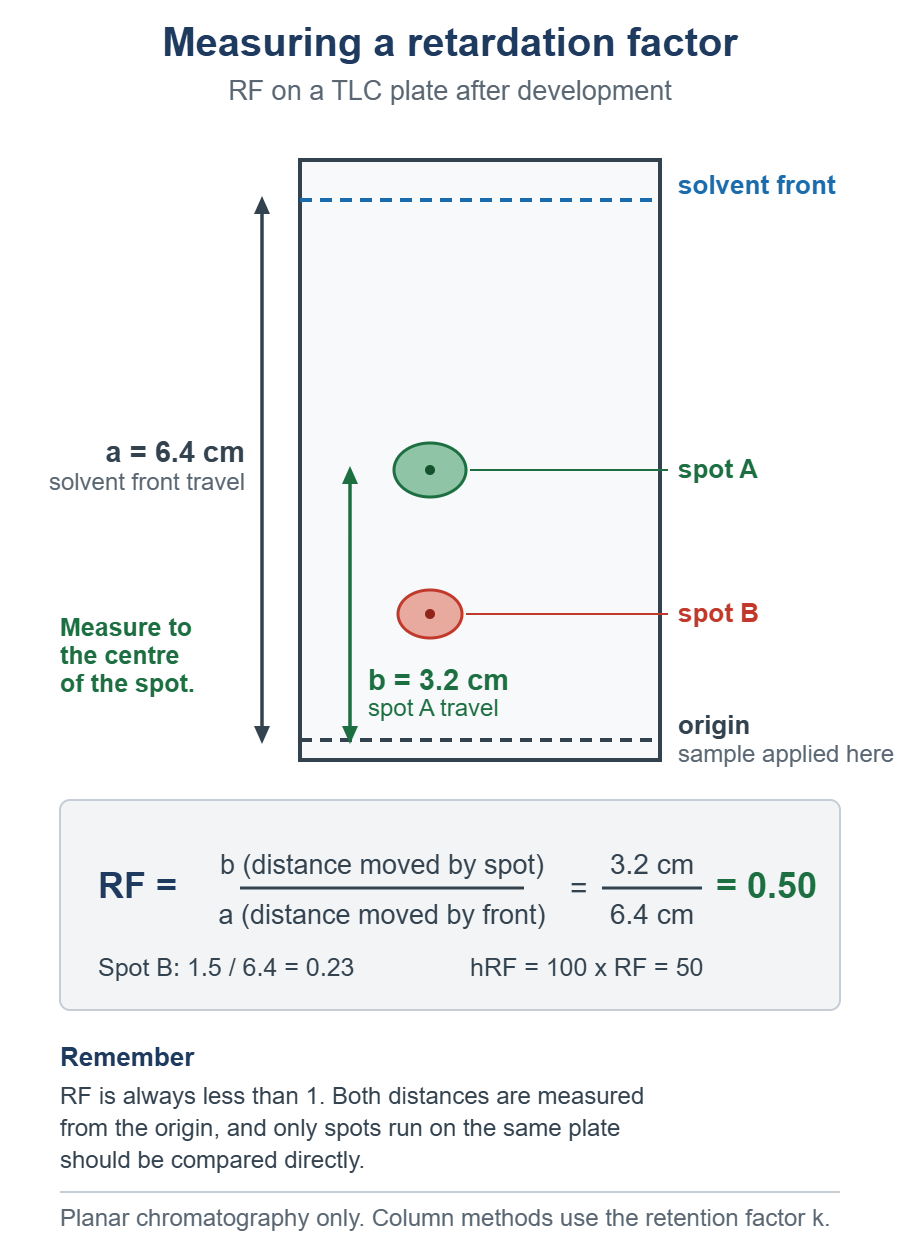
Both distances in Figure 1 are measured from the origin to the centre of the spot, not its leading or trailing edge — a spot that has streaked will give a different answer depending on where you measure it. This calculation gives a dimensionless RF value which, by definition, is less than 1. The lack of units makes RF values simple to compare, irrespective of the measurement system used.
Let’s see an example:
- If a substance travels 2.5 cm and the solvent front moves 5 cm.
- The RF value would be 2.5 cm / 5 cm = 0.5.
Common Mistakes to Avoid:
- Inaccurate Measurements: Use precise tools for measuring distances.
- Mixing Units: Ensure consistent units for both measurements.
The value is context-dependent, influenced by factors like solvent choice and chromatography medium. This sensitivity requires consistent conditions for reliable comparisons.
Understanding how to calculate and interpret the RF is crucial for anyone working with chromatographic techniques. By mastering this skill, you can confidently identify compounds and optimize your analytical processes. This knowledge forms the foundation for advanced chromatographic studies and applications.
Step-by-Step Guide: How to Find and Calculate RF Values
Locating and calculating RF values in chromatography might seem daunting initially, but breaking it down makes the process manageable. Here’s a detailed guide to help you along the way.
Start by preparing your chromatographic setup. Choose the right type of chromatography, such as thin-layer chromatography (TLC). Make sure your stationary phase, like the TLC plate, is properly positioned and ready to use.
Next, apply your sample. Use a capillary or a micropipette to place small spots of the sample along the baseline. Ensure each spot is consistently sized and spaced.
Prepare your solvent mixture as the mobile phase. Consider the sample’s polarity and use a solvent system that provides distinct separations.
Conducting the Run:
- Place the plate in the chamber so the mobile-phase level sits below the application line. If solvent reaches the spots they dissolve into the reservoir instead of migrating.
- Let the solvent move up the plate by capillary action.
Monitor until the solvent front nearly reaches the top. Remove the plate and quickly mark the solvent front with a pencil.
After the plate dries, identify the spots. Use UV light or staining if necessary for better visibility.
Measuring Distances:
- Spot Movement: Measure from the baseline to the middle of each spot.
- Solvent Front Movement: Measure from the baseline to the solvent front mark.
Use these measurements to compute the RF value. Divide the distance traveled by the compound by the distance the solvent front moved.
Ensure you record all data promptly. Accurate documentation helps later analysis and comparison. This step-by-step guide ensures your RF calculations are both accurate and reliable, forming the basis of effective compound identification and analysis.
Incorporate these steps into your routine, and practice will make the method second nature, enabling precise chromatographic assessments.
hRF and relative retardation
Two derived quantities are worth knowing, because pharmacopoeial and HPTLC work uses them routinely.
hRF is RF multiplied by 100, which turns a two-decimal value into a whole number: an RF of 0.42 is an hRF of 42. It carries no extra information — it is a presentation convention.
Relative retardation (Rrel) is the more useful of the two. It is the RF of the analyte divided by the RF of a reference substance developed on the same plate. Because both experience the same solvent front, it reduces to the ratio of the two migration distances, and it can reduce sensitivity to some run-to-run variation, because analyte and reference experience the same development conditions. Where reproducibility matters, quoting Rrel against a co-spotted standard is more defensible than quoting an absolute RF.
Factors Affecting RF Values in Chromatography
Several factors can influence RF values in chromatography. Understanding these factors is crucial for accurate measurement and interpretation.
Solvent Composition: The choice and ratio of solvent components significantly impact RF values. The solvent’s polarity can alter the compound’s migration distance.
Temperature: Chromatography runs at different temperatures can produce varied RF values. Temperature alters solvent evaporation, mobile-phase transport and the adsorption or partition equilibria involved, so control development temperature where RF reproducibility matters.
Other notable influences include the nature of the stationary phase. The chemistry of the chromatographic medium interacts with compounds, changing how far they travel.
Key Factors:
- Stationary Phase Type: Choose the right material to obtain optimal separation.
- Sample Concentration: Overloading spots may distort RF values.
Examine experimental conditions and maintain consistency across runs. Slight variations can lead to different results, impeding reproducibility.
Environmental Conditions:
- Humidity: Can change the flow of solvent systems, especially in TLC.
- Chamber saturation: an unsaturated tank lets mobile phase evaporate from the plate and typically raises RF. Saturate the chamber and keep saturation time consistent.
Address these influences by adjusting protocols. Consistent methodologies reduce variation, providing dependable chromatographic data. Adhering to controlled conditions helps achieve reproducible RF values, essential for compound analysis.
RF Values in Different Chromatography Techniques
RF values are pivotal across various chromatography techniques. They aid in identifying and separating compounds efficiently. Different methods utilize these values uniquely.
Thin Layer Chromatography (TLC): In TLC, RF values quantify the mobility of substances on a silica or alumina plate. TLC is favored for its simplicity and speed. Researchers often use it to verify reaction progress or purity.
Paper Chromatography: Similar to TLC, paper chromatography employs RF values. Compounds move along a strip of paper by capillary action. It’s often used in educational settings for illustrating basic concepts.
Different stationary and mobile phase combinations lead to diverse results. Understanding each technique enhances the accuracy of RF measurements.
Chromatography Techniques:
- Column chromatography: RF is not used here. Column methods are described by the retention factor k = (tR − tM)/tM.
- Gas Chromatography (GC): Though not using RF values directly, GC relies on retention times, providing analogous information.
Supercritical fluid chromatography (SFC) is sometimes grouped with these techniques, but it is a column method and does not use RF values.
Considerations for Technique Selection:
- Resolution Needs: Choose the method based on required separation quality.
- Sample Type: Different phases suit varying molecular properties.
Each method has unique benefits and limitations. Selecting the appropriate technique depends on the desired outcome and compound characteristics. Understanding how RF values integrate with each method enhances analytical efficiency and accuracy.
Applications of RF Values in Analytical Chemistry
RF values are instrumental in analytical chemistry. They help distinguish and identify compounds in complex mixtures. This capability is vital in various fields.
Pharmaceuticals rely heavily on RF values. Analysts use these values to confirm the identity and purity of drugs. Consistent RF readings are crucial for meeting industry standards.
In environmental science, RF values assist in tracking pollutants. They help locate and tentatively identify contaminants; quantification requires a densitometric or image-based measurement with calibration. This information is key for environmental monitoring and remediation efforts.
Practical Applications:
- Forensics: Identifying unknown substances at crime scenes.
- Food Industry: Ensuring product safety and quality.
- Biochemistry: Analyzing metabolic components in biological samples.
Each of these areas benefits from the specificity RF values offer. Reliable readings result in accurate compound characterization. Thus, RF values are integral to the advancement and accuracy of analytical methods. This makes them indispensable in both research and practical applications.
Common Questions About RF Values in Chromatography
Many learners and practitioners have questions about RF values. A common query is, “What does RF stand for in chromatography?” RF stands for retardation factor — not “retention factor,” which is the column-chromatography quantity k. It is a dimensionless value used in planar chromatography.
Another frequent question is how to calculate RF values accurately. To find RF values, measure the distance traveled by the compound and the solvent front. Divide the former by the latter to calculate the RF value.
People often ask about the unit of RF values. Surprisingly, RF values have no units. They are a simple ratio representing relative distances.
Key Concepts:
- Are RF values always less than 1?: Yes. The analyte cannot travel further than the solvent front, so formally 0 ≤ RF < 1. A zone moving essentially with the front is reported as approaching 1.00.
- Do different solvents affect RF values?: Absolutely, since solvent polarity impacts how far compounds travel.
Some wonder why RF values can vary for the same compound. Conditions such as temperature and solvent composition can cause variation. Thus, keeping experimental conditions consistent is vital for reliable results.
Considerations:
- Why use RF values over other indicators?: RF values provide a quick assessment of compound mobility.
- Are RF values transferable between TLC methods?: No. Most other techniques do not use RF at all, and even between TLC systems the value shifts with stationary phase, mobile phase, chamber conditions, temperature and loading. Different chromatography methods may yield different RF values for the same compound.
Understanding RF values and their calculation can enhance your chromatography skills. Addressing these questions is crucial for mastering the concept in analytical applications.
Troubleshooting and Best Practices for Reliable RF Values
Achieving consistent and reliable RF values can be challenging without proper methods. One common issue is variability in RF values, which often arises from inconsistent experimental conditions. Ensuring uniform solvent composition and temperature across all runs can reduce discrepancies.
Proper measurement is crucial for accuracy. Use precise equipment to measure distances traveled by compounds and solvents. Always measure from the same points to ensure consistency across different trials.
Best Practices for Accurate RF Values:
- Maintain consistent laboratory conditions.
- Use fresh and clean chromatography media.
- Ensure solvents are of high purity.
Another best practice involves using quality chromatographic media. Impurities or damages on the media’s surface can skew results. Thus, it’s essential to inspect media before use.
Moreover, always document your procedures and results meticulously. Detailed notes allow for easier identification of procedural variations and can assist in troubleshooting issues. By adhering to these best practices, you can achieve more reliable and insightful RF values in your experiments.
Summary and Key Takeaways
RF values are fundamental to the field of chromatography, enabling the identification and separation of compounds. They provide insights into the interaction between compounds and the stationary phase. Understanding how to calculate and interpret RF values aids in successful chromatographic separations.
Ensuring accuracy in RF value determination involves consistent laboratory practices and precise measurement techniques. By mastering these aspects, professionals and students alike can enhance the reliability of their analytical results.
Key Takeaways:
- RF is unitless and, by definition, less than 1: formally 0 ≤ RF < 1. A zone migrating essentially with the front is reported as approaching 1.00.
- On normal-phase layers they give a relative indication of polarity: higher RF often means less polar. This does not hold on reversed-phase layers.
- Consistency in conditions yields reproducible RF values.
- RF is a qualitative, identification-related migration parameter. Quantitative TLC/HPTLC depends on measuring analyte response — densitometric or image-derived signal — against a calibration, not on RF itself.
- Proper documentation and quality control can improve RF value accuracy.
Diagnosing unexpected RF values
Most RF surprises trace back to a handful of variables. Table 1 lists the common ones — find your observation in the first column and work across.
| Observation | Most likely cause | What to do |
|---|---|---|
| All RF higher than usual | Mobile phase too strong, or the chamber was not saturated so solvent evaporated from the plate | Remake the mobile phase to composition; line the tank and allow a consistent saturation time |
| All RF lower than usual | Mobile phase too weak, or the layer is more active than usual (drier plate) | Check composition and solvent age; standardise plate activation and storage |
| RF drifts run to run | Humidity, saturation time or solvent evaporation varying between runs | Control the room, keep saturation time fixed, and co-spot a reference standard to report relative retardation |
| Streaking or tailing | Overloading, strong adsorption, or an ionisable analyte without a modifier | Reduce load; evaluate an acidic or basic modifier chosen for the analyte’s ionisation, the layer chemistry and the method objective |
| Diffuse, broad zones | Application volume too large, or an over-strong sample solvent | Apply less, in a weaker solvent, and dry between applications |
| Curved or uneven solvent front | Plate not seated squarely, or uneven saturation in the tank | Reposition the plate and re-saturate the chamber before developing |
References
- IUPAC, Compendium of Chemical Terminology (Gold Book) — retardation factor, RF, in planar chromatography. Source: Pure Appl. Chem. 1993, 65, 819 (Nomenclature for chromatography), p. 845.
- IUPAC Gold Book — retention factor, k, in column chromatography. Establishes that k is the column quantity and that the prime in k′ is redundant.
- IUPAC Gold Book — RM value in planar chromatography, from which the relationship RF = 1/(1 + k) follows.
- European Pharmacopoeia 2.2.27, Thin-layer chromatography — definition of the retardation factor, chamber saturation and plate activation conditions.
- United States Pharmacopeia — General Chapter <621> Chromatography: retardation factor (RF), relative retardation (Rr) and retention factor (k) definitions.
- Merck / MilliporeSigma — Tips & Tricks for Thin-Layer Chromatography: hRF, plate conditioning, chamber saturation and practical RF windows.