
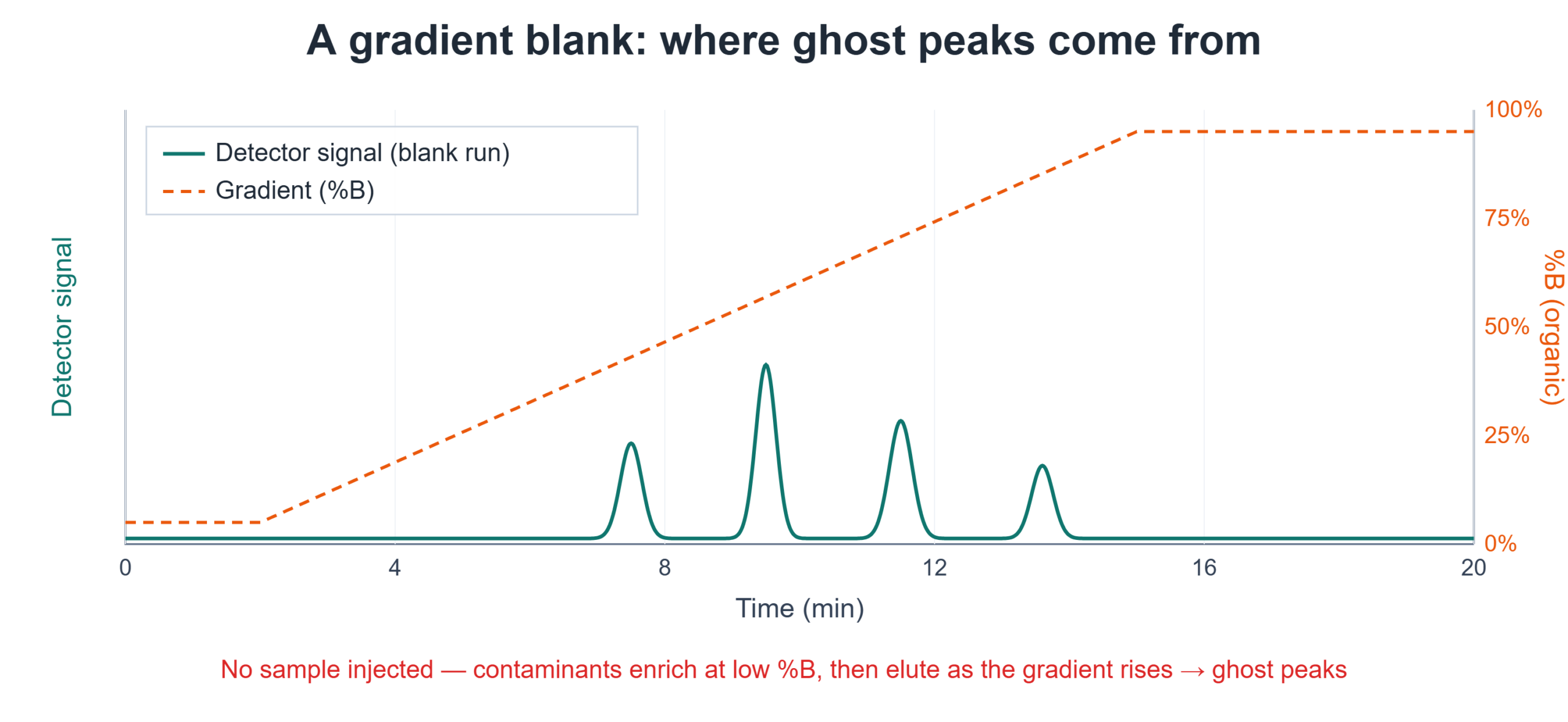
You inject a blank — pure solvent, no sample — and peaks appear anyway. Figure 1 shows the classic pattern. Or your gradient runs show extra peaks that aren’t in your standards, drifting in and out from one sequence to the next. These are ghost peaks (also called artifact or system peaks): signals that don’t come from your sample. They masquerade as analytes, inflate impurity counts, break integration, and can fail a method outright — and they’re worst in gradient methods and trace-level work, exactly where you can least afford them.
Ghost peaks feel random, but they almost never are. This guide gives you the one test that localizes them immediately, the mechanism that explains why gradients are so prone to them, and a systematic path to find and eliminate the source.
The one test that localizes everything: run a blank
Before changing anything, inject a blank — your mobile phase or sample diluent with no analyte — and run your normal method. This single experiment splits the problem in two:
- If the ghost peaks appear in the blank, they’re coming from your system, solvents, or mobile phase — not your sample. This is the usual case.
- If the blank is clean and ghost peaks show only with real samples, the source is the sample, the diluent, or carryover from previous injections.
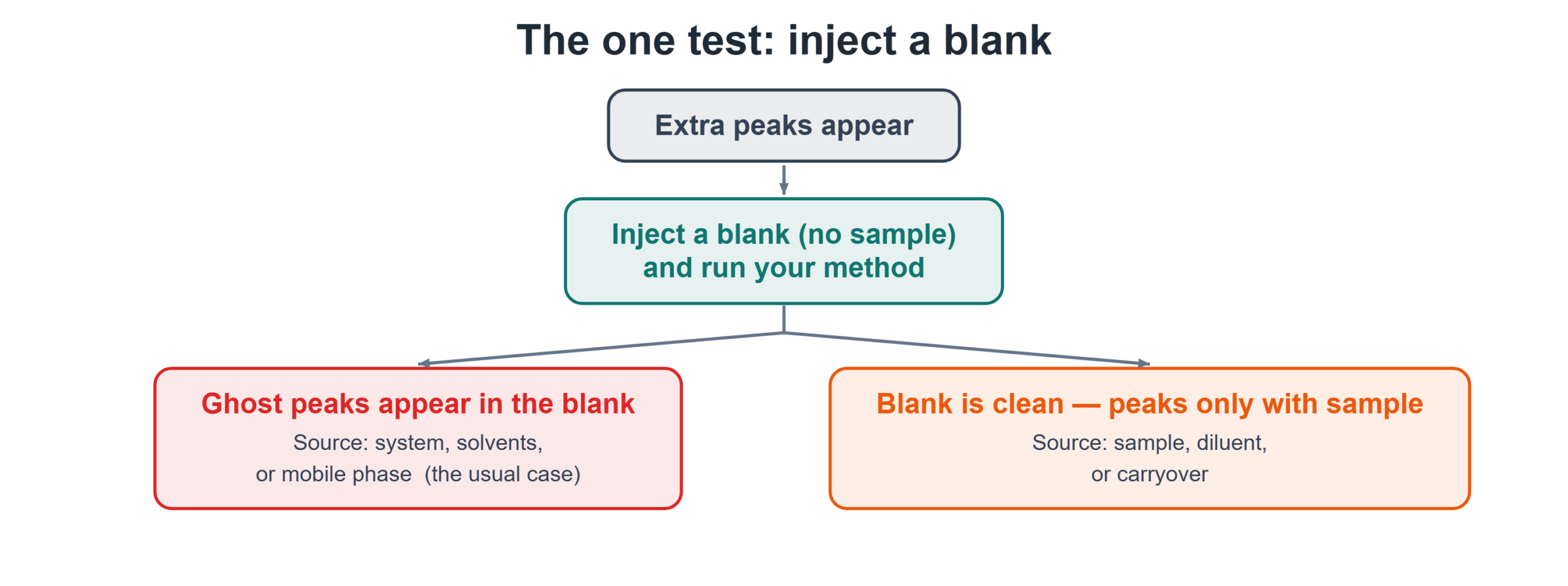
Figure 2 sets out the decision. Everything that follows depends on which branch you’re in. Most ghost-peak investigations live in the first, so we’ll start there.
Chromatography Troubleshooting Decision Engine
Any HPLC symptom, one starting point — the engine narrows hundreds of failure modes to the few that fit your evidence.
Why gradients are the usual culprit
Ghost peaks are overwhelmingly a gradient phenomenon, and understanding why tells you exactly where to look. During the low-organic hold at the start of a gradient, weakly retained contaminants in your aqueous mobile phase are continuously loaded onto — and concentrated at — the head of the column, run after run. They sit there enriching until the gradient’s organic strength rises enough to elute them, at which point they come off as sharp, focused peaks, exactly as if you had injected them.
This is why an isocratic method rarely shows ghost peaks while the same solvents in a gradient method do: the gradient both accumulates the contaminant and then focuses it into a discrete peak. It also hands you a powerful diagnostic.
The equilibration-time test
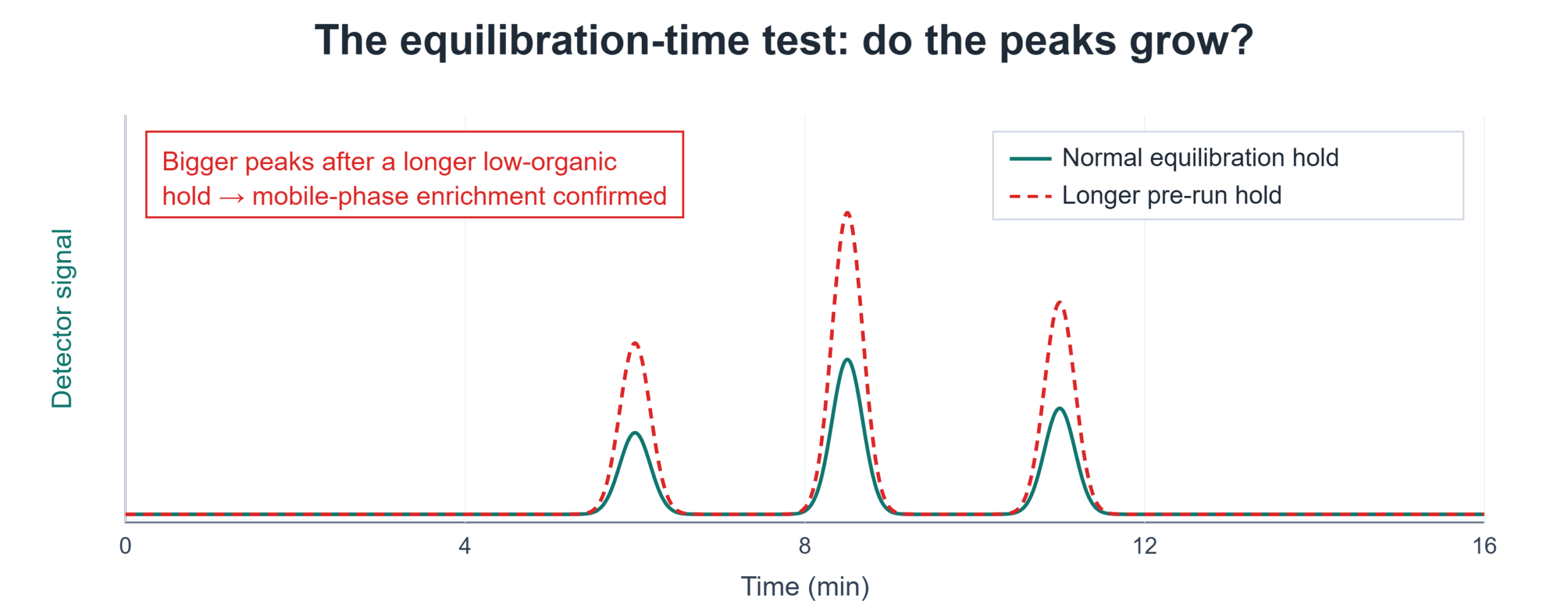
Figure 3 shows the expected result. If mobile-phase enrichment is at work, the ghost peaks should grow when you give the column more low-organic time to accumulate contaminant. Run your gradient blank twice — once with your normal hold, once with a much longer pre-run hold at starting conditions. If the ghost peaks get bigger with the longer hold, you’ve confirmed the contaminant is being loaded from your aqueous line rather than injected. If they don’t change, the source is more likely per-injection: diluent, carryover, or needle wash.
Cause 1: The aqueous mobile phase and water
The most common source. Water is deceptively easy to contaminate: purification units that aren’t serviced grow bacteria whose decomposition products are UV-active and elute as ghost peaks; RO or deionized water often underperforms HPLC-grade water in gradients; and stored aqueous phases grow microbes over days. Test it by swapping your water source and re-running the gradient blank. Prevention: use fresh HPLC/LC-MS-grade water, add a small proportion of organic modifier to aqueous phases that must be stored — around 15% methanol is a widely used figure, and even a few percent of acetonitrile suppresses growth — refrigerate them, and keep reservoir bottles scrupulously clean1.
Cause 2: Organic solvents, buffers, and additives
Even HPLC-grade reagents carry trace impurities, and they vary by brand and lot. Acids, buffer salts, and ion-pairing additives are frequent offenders because they’re used at relatively high concentration. The definitive test is brand-by-brand substitution: hold everything constant and swap one reagent brand at a time, comparing blank chromatograms. When a ghost peak disappears, you’ve found its source. As a habit, record the vendor and part number of every solvent and reagent in the method — it stops the problem reappearing after a reorder or method transfer.
Cause 3: Sample diluent and carryover
If the blank is clean but samples show extra peaks, look at the diluent first — impurities there behave just like mobile-phase contaminants. Carryover is the other suspect: strongly retained compounds from a previous high-concentration injection can bleed out during later runs and appear as ghosts. Confirm carryover by injecting a blank immediately after a high-concentration sample; if ghost peaks appear there but not in a standalone blank, you have carryover. The fix is a stronger or longer needle/injector wash and, where needed, an extended end-of-run flush.
Cause 4: Wash solvents, seals, and bottles
Needle wash, seal wash, and reservoir bottles are easy to overlook and a common hidden source. Detergents are a particular hazard — never wash HPLC bottles with surfactant-based detergent, because residual surfactant gives its own ghost peaks. Keep wash solvents fresh and bottles clean and dedicated.
A diagnostic flow you can follow
- Inject a blank — in-blank peaks = system/mobile phase; sample-only = diluent or carryover.
- Compare gradient vs isocratic — gradient-only points to mobile-phase enrichment.
- Vary the equilibration time — peaks that grow confirm aqueous-phase loading.
- Swap the water source, then each reagent brand one at a time, to isolate the contaminated component.
- Inject a blank after a high sample to test for carryover.
- Check wash solvents and bottles — and never use detergents.
Eliminating them for good
Once you’ve isolated the source, prevention is straightforward: high-purity, brand-specified solvents; fresh, antimicrobial-protected aqueous phases; clean bottles and wash lines; and, for stubborn gradient contamination, a ghost-trap column installed between the pump and injector, which adsorbs mobile-phase contaminants before they reach the analytical column. Starting the gradient at a slightly higher organic percentage also shrinks the low-organic enrichment window.
The takeaway
Ghost peaks are a contamination-localization problem, not a mystery. One blank injection tells you whether you’re chasing the system or the sample; the gradient-focusing mechanism tells you why the peaks appear where they do; and swapping one reagent at a time tells you exactly which bottle to replace. Work from those three moves and the ghosts stop being random.
Related troubleshooting guides: Autosampler carryover in HPLC and LC-MS and HPLC baseline noise and drift.
Facing extra peaks you can’t explain? Let LabVeda’s Chromatography Troubleshooting Decision Engine walk you through the diagnosis step by step.
References
- Agilent — HPLC: Best Practices for Aqueous Mobile Phases. The exact proportion of organic modifier needed to suppress microbial growth is not fixed by any standard; treat these as working figures rather than specifications.