
Structured, Mechanistic Diagnosis for HPLC / LC–MS Systems
Tailing peak that’s always been there?
Sudden tailing after a column or fitting change?
Only your basic analytes tailing?
Getting worse with every batch?
Peak tailing is one of the most common — and most misattributed — chromatography symptoms. It’s rarely “just the column.”
This Peak Tailing Troubleshooter analyzes your peak shape pattern, system history, and method chemistry, then ranks the most probable causes, with confirmation tests and corrective actions. Whether you’re seeing a subtle asymmetry or a badly distorted peak, this diagnostic engine narrows the field before you touch the system.
🚀 What This Tool Does
The Peak Tailing Troubleshooter evaluates:
- Column void or bed channeling
- Secondary silanol interactions
- Injection solvent mismatch
- Column overload
- Extra-column dead volume
- Mobile phase pH proximity to analyte pKa
- Fitting and connection issues
Instead of guessing which one it is, you receive:
- 🔎 Ranked root causes
- 🧪 Targeted confirmation tests
- 🛠 Step-by-step corrective actions
- 📘 Preventive maintenance guidance
Built for real laboratory workflows.
🎯 Designed For
- HPLC and LC–MS users
- Analytical chemistry labs
- Bioanalysis groups
- QC environments
- Method development teams
- Scientists maintaining regulated systems
Whether the tailing is chronic or newly appeared, this tool narrows the cause quickly.
🧠 Why It’s Different
Most troubleshooting guides:
- Are static flowcharts
- Assume generic setups
- Ignore real-world system variables
- Provide long lists without prioritization
LabVeda combines:
- 15+ years of chromatography experience
- Structured diagnostic logic
- AI-assisted hypothesis scoring
- Practical confirmation workflows
You get ranked causes — not guesswork.
📏 Understanding the USP Tailing Factor
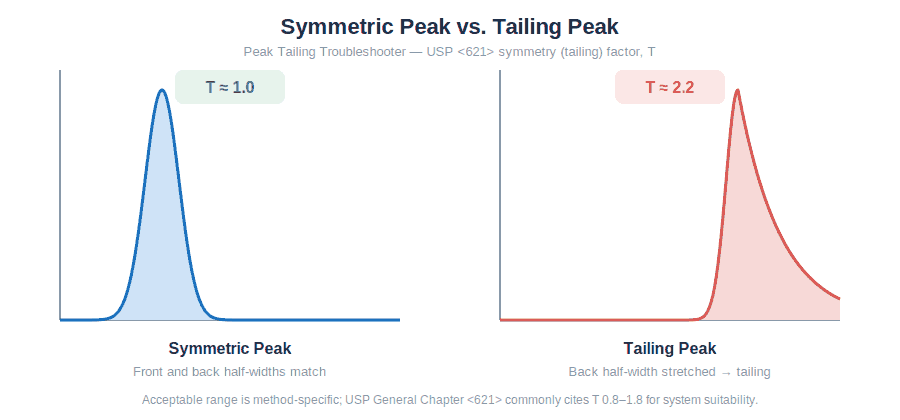
Peak tailing isn’t just a visual annoyance — it’s a defined, measurable parameter. Under USP General Chapter <621>, the symmetry (tailing) factor, T, is 1.0 for a perfectly symmetrical peak, and increases as tailing becomes more pronounced. Most compendial methods specify an acceptable range, commonly 0.8–1.8, as part of system suitability testing.
Knowing where your peak actually falls on that scale matters before you start troubleshooting. A tailing factor of 1.3 calls for a different level of urgency than one of 2.5, and the acceptable range in your own method may be tighter or looser than the general compendial default depending on what’s specified in your validated procedure. If you haven’t calculated it recently, it’s worth doing before working through the questions below — it gives you a concrete severity baseline to compare against after you’ve made a fix.
This is also why the diagnostic path matters more than a single fix-it tip: a tailing factor creeping from 1.1 to 1.4 over weeks points somewhere very different than one that jumped from 1.1 to 2.8 overnight, even though both are technically “tailing.” The questions in this Peak Tailing Troubleshooter are built around exactly that kind of distinction, rather than a one-size-fits-all checklist.
⏱ Takes 2–3 Minutes
Answer a short set of focused questions about:
- Onset pattern
- Analyte class and mobile phase chemistry
- Column age and history
- Injection conditions
- Recent system changes
The engine calculates weighted probabilities and returns a ranked troubleshooting plan.
🧪 Example Output
Most Likely Cause: Secondary interactions with residual silanols
Confidence: 68%
Why: Basic analyte, mobile phase pH within 1 unit of pKa, tailing specific to basic compounds only
Confirm: Increase buffer concentration and re-run; compare peak shape
Fix: Adjust pH away from analyte pKa or switch to a base-deactivated column chemistry
Prevent: Select column chemistry and buffer pH around analyte pKa during method development
Clear. Actionable. Lab-ready.
🛠 Built for Practical Laboratories
This tool supports:
- Routine troubleshooting
- Pre-validation system qualification
- Investigations of degrading peak shape
- Method development chemistry checks
Related troubleshooting guides: Why your HPLC peaks are tailing and Ghost peaks in HPLC.
Looking for other diagnostics? Try the High Backpressure Troubleshooter or explore the full Chromatography Troubleshooting Decision Engine.