
HPLC system suitability testing (SST) is a predefined check that verifies the chromatographic measurement system and the analytical operations of a procedure are adequate for the intended analysis before results are reported. It is not a generic instrument-health score and not a substitute for analytical procedure validation; the right parameters and acceptance criteria depend on the procedure and its governing framework.1
A useful SST monitors the attributes that matter to the procedure — critical-pair resolution, injection repeatability, peak shape, efficiency, retention behavior or detector response — against predefined criteria. When it fails, the correct response is to preserve the data, diagnose the failure systematically, correct the justified root cause, and re-establish suitability under the applicable procedure, not to keep injecting until a passing result appears.
What is HPLC system suitability?
System suitability testing evaluates the combined performance of the chromatographic measurement system and the analytical operations relevant to a specific procedure. Current analytical-procedure lifecycle guidance frames SST as a way to confirm the measurement system is adequate for the intended analysis and to increase the detectability of potential failures.1
The word system matters. Results can be affected by the pump and gradient delivery, the injector, the column, thermostatting, the detector, acquisition settings, mobile phases, standards, analyst operations, and the procedure itself. SST is therefore not a test of the HPLC instrument alone, and a passing SST does not prove that a procedure is validated: validation establishes fitness for the intended purpose across defined performance characteristics, while SST is a procedure-defined operational performance check.2
Chromatography Troubleshooting Decision Engine
Any HPLC symptom, one starting point — the engine narrows hundreds of failure modes to the few that fit your evidence.
Why does system suitability matter?
A well-designed SST connects method-critical chromatographic behavior to measurable, predefined criteria. It detects performance problems before they compromise reportable results; provides a readiness check after setup, equilibration, maintenance or instrument transfer; helps separate a system-performance problem from a sample-specific one; and creates a documented decision point for proceeding, pausing or investigating a sequence. SST is most valuable when its parameters are scientifically tied to the analytical objective — a related-substances method may hinge on critical-pair resolution, while a quantitative assay may emphasize injection repeatability and response — so the correct SST is procedure-specific rather than universal.
How is SST different from instrument qualification and method validation?
These three activities answer different questions and none replaces another. Instrument qualification asks whether the equipment is installed, operates and performs within qualified specifications. Validation asks whether the procedure is fit for its intended purpose across defined performance characteristics. SST asks whether the configured measurement system and analytical operations are adequate for a particular procedure at the time of use. A qualified HPLC can still fail SST, and a passing SST replaces neither qualification, calibration and maintenance nor validation. FDA guidance is explicit that system-suitability data alone are insufficient to constitute method validation.3 Table 1 sets the three side by side.
| Activity | Question it answers | When it applies | What it does not do |
|---|---|---|---|
| Instrument qualification | Is the equipment installed and performing within qualified specifications? | At installation and periodically per the qualification program | Does not confirm a specific procedure performs on the day of use |
| Method validation | Is the procedure fit for its intended purpose across defined characteristics? | During development/validation and on significant change | Is not re-established by a passing SST |
| System suitability (SST) | Is the configured system adequate for this procedure right now? | At time of use, before and during a sequence | Does not replace qualification, calibration, maintenance or validation |
What is a practical system-suitability workflow?
Running SST is a defined sequence, not a single injection. Figure 1 shows the workflow and the steps below give the same order; the aim at each stage is a documented decision about whether the system is ready.
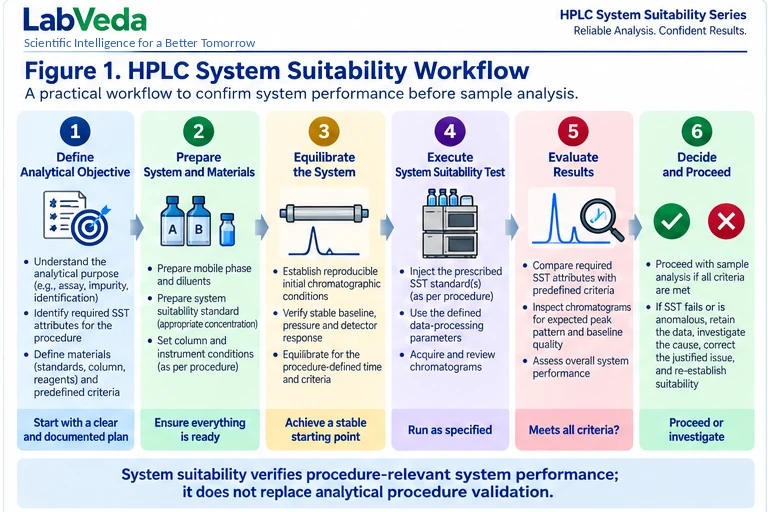
- Define: identify the analytical objective, the critical chromatographic attributes, the SST material and the predefined acceptance criteria.
- Prepare: prepare mobile phases and standards and configure the system per the controlled procedure — column, detector, flow, temperature and gradient or isocratic conditions.
- Equilibrate: establish reproducible initial conditions appropriate to the method; do not assume a fixed number of column volumes guarantees full equilibrium for every method.
- Execute: run the required suitability injections in the prescribed sequence using the defined material and data-processing method.
- Evaluate: compare every required attribute with its predefined criterion, and inspect the chromatograms as well as the calculated values.
- Decide: proceed per the procedure, or, if SST fails or behaves anomalously, retain the data and investigate rather than testing into compliance.
What do the common system-suitability parameters monitor?
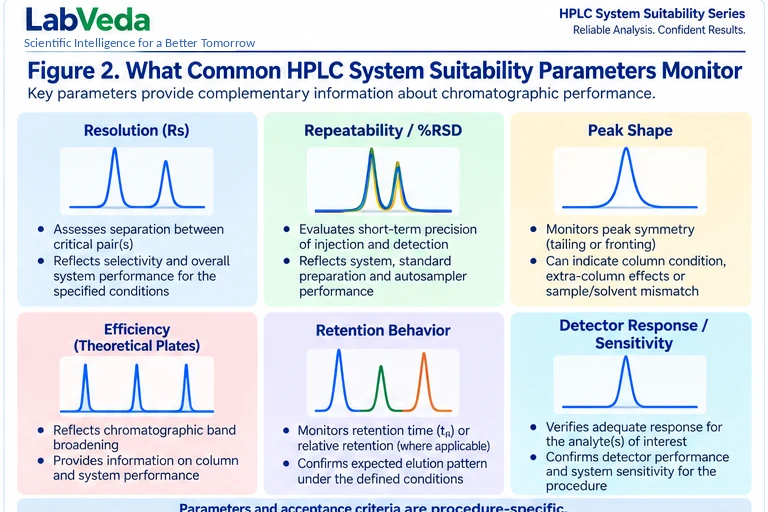
The parameters that appear in SST each report on a different aspect of chromatographic performance, and which ones apply is procedure-specific. Figure 2 illustrates the common parameters and Table 2 summarizes what each monitors and the interpretation it demands.
| Parameter | What it monitors | Interpretation caution |
|---|---|---|
| Resolution, Rs | Separation between peaks, especially a critical-pair resolution that controls selectivity or quantitation | Interpret against the procedure-defined pair and criterion; there is no universal Rs threshold |
| Repeatability (%RSD) | Short-term repeatability of response, retention time or another result across replicate injections | Injection count and permitted %RSD come from the applicable procedure, not a default |
| Peak shape (tailing / symmetry) | Secondary interactions, overload, extra-column effects, solvent mismatch or column deterioration | Calculation conventions for asymmetry and tailing differ |
| Efficiency / plate number, N | Band broadening, expressed as an efficiency descriptor (plate number) from retention and peak width | The value depends on the calculation convention, the selected peak and data processing; it is not a column-only property |
| Retention behavior | Retention time or relative retention where meaningful | A retention shift is a symptom, not a root cause — flow, composition, temperature, gradient timing and equilibration all contribute |
| Detector response / sensitivity | Response or detectability where adequate quantitation is required | The metric should be procedure-defined rather than imposed generically |
Which equations does system suitability use, and how?
System-suitability equations are useful only when the definition and calculation convention are stated, because pharmacopoeial and software conventions can use different peak-width definitions.4 Resolution in the common baseline-width form is:
Rs = 2(tR2 − tR1) / (w1 + w2)
where tR1 and tR2 are the retention times of the two peaks and w1, w2 are their baseline widths; other definitions use half-height widths and different constants, so the value only means something once the convention is fixed. Injection precision is reported as the percent relative standard deviation:
%RSD = 100 × s / x̄
where s is the sample standard deviation of the replicate results and x̄ is their mean. Plate-number equations likewise depend on the peak-width convention,5 so report the convention used by the controlled procedure or the chromatography data system rather than assuming one universal form.
How do you troubleshoot a failed system suitability test?
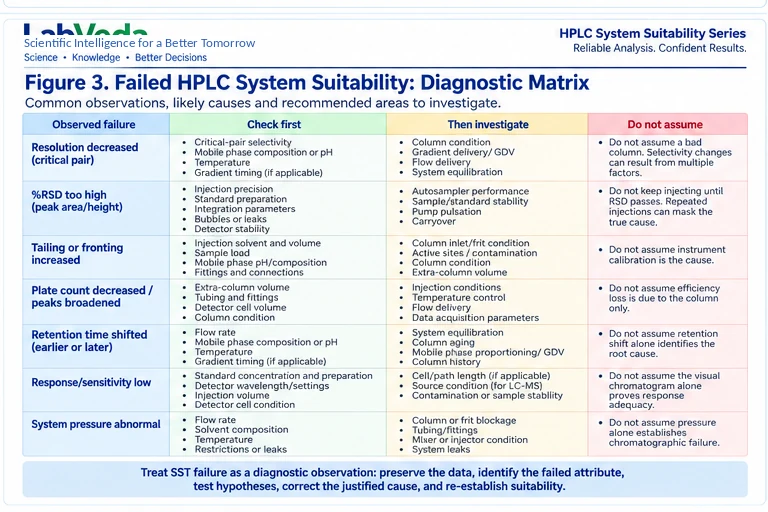
Treat a failed SST as a diagnostic observation. Start with the failed attribute and ask which physical mechanisms can produce that pattern, rather than changing several method parameters at once. The same discipline maps each failure to a small set of likely causes: a resolution failure points to selectivity, retention or critical-pair geometry; a repeatability failure to injection, preparation, integration, fluidics or detector stability; a peak-shape failure to sample solvent, load, pH, secondary interactions, fittings or the column inlet; an efficiency failure to dispersion, column condition, injection or acquisition settings; a retention failure to flow, composition, temperature, gradient timing or equilibration; and a pressure failure to flow, viscosity, temperature, restrictions or leaks. Figure 3 and Table 3 give the full symptom-to-cause map, including the assumptions worth avoiding.
| Observed failure | Check first | Then investigate | Do not assume |
|---|---|---|---|
| Resolution decreased (critical pair) | Critical-pair selectivity; composition/pH; temperature; gradient timing | Column condition; gradient delivery/GDV; flow delivery; equilibration | A bad column — selectivity changes have several causes |
| %RSD too high | Injection precision; standard prep; integration; bubbles/leaks; detector stability | Autosampler; sample stability; pump pulsation; carryover | That you can keep injecting until %RSD passes |
| Tailing / fronting worsened | Injection solvent and volume; load; pH; fittings | Column inlet/frit; active sites; contamination | That peak-shape failure means the instrument needs calibration |
| Plate count decreased / peaks broadened | Extra-column volume; tubing/fittings; detector cell; column condition | Injection; temperature; flow; data rate/filtering | That the loss is due to the column only |
| Retention shifted | Flow; mobile phase; temperature; gradient start/delay | Equilibration; column aging; proportioning; GDV | That the retention shift alone identifies the root cause |
| Response / sensitivity low | Standard; wavelength; detector settings; injection volume | Cell/path length; source condition; contamination; stability | That a visually acceptable chromatogram proves response is adequate |
| Pressure abnormal | Flow; solvent composition; temperature; restrictions/leaks | Column/frit blockage; tubing; mixer/injector | That a pressure difference alone establishes chromatographic failure |
What should you not do after an SST failure?
In a CGMP setting, failing, passing, obvious-error and suspect data must all be retained and reviewed, and an appropriate standard injection used to assess system readiness is distinct from an unofficial trial injection of a product sample.6 The following are not defensible responses to a failed SST:
- Discarding, overwriting or ignoring failing or suspect data.
- Performing unofficial sample trial injections to see whether the system now passes.
- Repeatedly injecting until a statistically favorable replicate set appears.
- Changing several variables at once without a hypothesis and a documented rationale.
- Replacing the column before checking mobile phase, injection, temperature, flow, fittings and system configuration.
- Changing procedure-defined acceptance criteria after seeing the result.
How does system suitability apply after method transfer?
Method transfer is a clear use case for SST. The source and target systems need not be physically identical; the transferred procedure must demonstrate acceptable performance against predefined, procedure-specific criteria, which is exactly what a full HPLC method transfer sets out to establish.7 If a transferred method fails SST, compare the system characteristics before changing the procedure: gradient delay volume, flow-delivery architecture, thermostatting, injection configuration, extra-column dispersion, detector cell volume, acquisition settings and column configuration can all change chromatographic behavior even when the programmed method is identical. A retention change that looks like a selectivity problem is often drifting retention from equilibration or delay-volume differences instead.
How do compendial procedures affect SST requirements?
For a USP or other compendial procedure, use the current applicable general chapter, the individual monograph and the laboratory quality framework when setting SST requirements and any permitted chromatographic adjustments.4 Do not generalize a limit or an adjustment provision from one monograph or compendial context to every HPLC method, and do not treat any single numerical threshold — a resolution value, a %RSD or a tailing factor — as a default LabVeda limit. Any numbers you carry over are method- or source-specific.
Where does SST fit in the analytical procedure lifecycle?
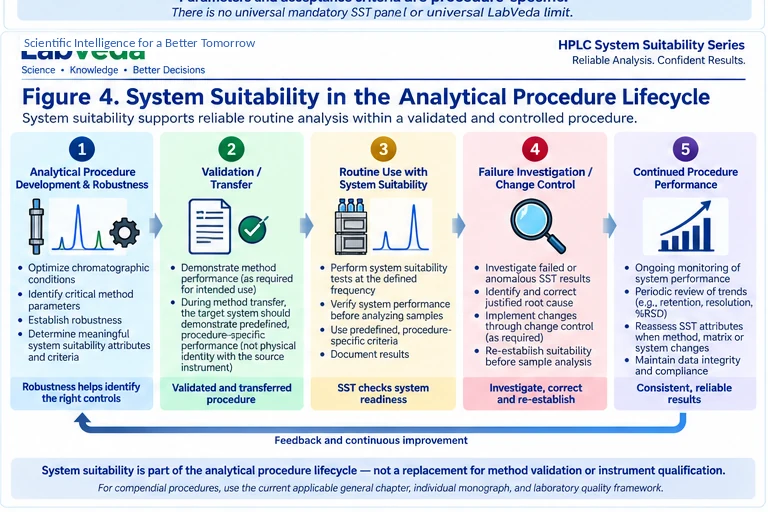
System suitability is one link in the analytical procedure lifecycle, not a standalone gate. Robustness work during development helps identify the variables that materially affect performance and therefore which SST parameters are meaningful;1 validation and transfer establish and confirm fitness for purpose; routine SST then checks readiness at time of use; and failure investigation and continued-performance monitoring feed improvements back into the method. Figure 4 places SST in that cycle.
Frequently asked questions
What is HPLC system suitability?
It is a procedure-defined evaluation used to verify that the chromatographic measurement system and the associated analytical operations are adequate for the intended analysis before results are reported.
Is SST the same as calibration?
No. Calibration or qualification evaluates equipment against technical requirements; SST evaluates the procedure-relevant performance of the configured chromatographic system at the time of use.
Does every HPLC method need the same SST parameters?
No. Parameters and acceptance criteria should reflect the analytical procedure, its intended purpose and the applicable compendial or quality framework. There is no universal mandatory panel.
What should I do if SST fails?
Retain the data, identify the failed attribute, investigate the likely physical causes systematically, correct the justified root cause under the applicable procedure, and re-establish suitability as required — rather than testing into compliance.
Can I keep injecting until %RSD passes?
No; that is not a scientifically defensible strategy. In regulated work all data must be retained and reviewed, and repeated testing should follow written procedures and a justified investigation.
Does passing SST prove the method is validated?
No. SST is an operational performance check at time of use and is not a substitute for analytical procedure validation.
The takeaway
System suitability is the check that the whole chromatographic system — not just the instrument — is fit to run a specific procedure right now, measured against criteria the procedure defines rather than any universal numbers. Its value comes from tying a few procedure-critical attributes to predefined limits, reading the chromatograms alongside the calculated values, and, when a criterion fails, treating the failure as a diagnostic starting point: preserve the data, map the symptom to its likely mechanisms, correct the justified cause, and re-establish suitability. Kept in its place in the lifecycle, SST supports reliable results without ever standing in for qualification or validation.
Working through an SST failure? A free LabVeda account saves your diagnostics, method sessions and exports across visits — the Knowledge Hub and tools stay open to everyone.
References
- International Council for Harmonisation, ICH Q14 Analytical Procedure Development (FDA guidance for industry, March 2024).
- International Council for Harmonisation, ICH Q2(R2) Validation of Analytical Procedures (FDA guidance for industry, March 2024).
- U.S. Food and Drug Administration, Analytical Procedures and Methods Validation for Drugs and Biologics (Guidance for Industry, July 2015).
- United States Pharmacopeia, General Chapter ⟨621⟩ Chromatography, USP–NF (current applicable text; consult the individual monograph).
- L. R. Snyder, J. J. Kirkland and J. W. Dolan, Introduction to Modern Liquid Chromatography, 3rd ed., Wiley (2010).
- U.S. Food and Drug Administration, Questions and Answers on Current Good Manufacturing Practice — Laboratory Controls (data retention and testing-into-compliance guidance).
- Waters Corporation, “Global Cross Lab Method Transfer of a USP Impurities Method on the Alliance iS HPLC System” (application note, 2024).
Further reading
- United States Pharmacopeia, General Chapter ⟨1058⟩ Analytical Instrument Qualification — the qualification counterpart to the SST discussed here.
Reviewed against primary sources. The definitions, distinctions and equations on this page are checked against ICH Q2(R2) and Q14, FDA analytical-procedure and CGMP guidance, and USP General Chapter ⟨621⟩. No universal numerical suitability limits are given; any example values are method- or source-specific, not LabVeda defaults. For validated or compendial methods, the applicable procedure, monograph and regulatory framework take precedence over the general guidance here. Evidence review: September 2026.