
HPLC method robustness is the capacity of an analytical procedure to meet its expected performance requirements during normal use when procedure parameters are varied deliberately within scientifically justified ranges. Under ICH Q14, robustness is evaluated by deliberate variation of procedure parameters, guided by prior knowledge and risk assessment.
A useful robustness study does more than show that a chromatogram still looks acceptable after small changes. It identifies which parameters materially influence performance, detects interactions where they matter, establishes defensible operating ranges or controls, and feeds the analytical procedure control strategy—including meaningful system-suitability checks. Robustness is method understanding, not simply a pass or fail exercise.
What is HPLC method robustness?
Robustness asks a practical question: if normal analytical conditions vary within plausible operating ranges, does the procedure continue to meet its expected performance requirements? ICH Q14 defines robustness in terms of the capacity to meet expected performance criteria during normal use, and specifies deliberate variation of analytical procedure parameters as the experimental approach.1
For HPLC, the relevant variables can include mobile-phase composition, pH or buffer conditions, flow rate, column temperature, gradient timing or composition, column-related factors, injection conditions, and sample-preparation variables. The correct variables are not selected from a universal checklist. They are selected because prior knowledge, risk assessment, development data, transfer experience, or mechanistic understanding indicates that their variation could affect the analytical result.
Chromatography Troubleshooting Decision Engine
Any HPLC symptom, one starting point — the engine narrows hundreds of failure modes to the few that fit your evidence.
How does robustness differ from ruggedness, validation and system suitability?
These concepts are related but not interchangeable. Robustness concerns deliberate parameter variation; intermediate precision concerns reproducibility across analysts, days and equipment; validation asks whether the procedure is fit for its intended purpose; and system suitability confirms that the measurement system is fit at the time of use. Robustness knowledge is what tells you which system-suitability attributes are worth monitoring in the first place. Table 1 sets out the distinction.
| Concept | Primary question | Typical focus |
|---|---|---|
| Robustness | Can the procedure tolerate deliberate variation of method parameters during normal use? | Procedure parameters and their effects and interactions |
| Intermediate precision / ruggedness-like variability | How reproducible is performance across relevant analysts, days, equipment or environmental conditions? | Sources of random and operational variability |
| Validation | Is the analytical procedure fit for its intended purpose? | Performance characteristics such as accuracy, precision, specificity, range and response |
| System suitability | Is the measurement system fit for the intended analysis at the time of use? | Procedure-defined readiness and performance attributes |
The relationship to routine performance checks is developed further in the HPLC system suitability guide; robustness identifies the sensitivities that make a given system-suitability test worth running.
When should you evaluate HPLC robustness?
ICH Q14 states that robustness evaluation is generally conducted during analytical procedure development. If it is adequately evaluated during development, it does not need to be repeated during validation, and validation data such as intermediate precision can complement robustness knowledge.1 The relationship between development studies and formal validation parameters is defined in ICH Q2(R2).2
In practice, robustness deserves attention at several points:
- During method development, once the major separation conditions are established.
- Before finalizing operating ranges and the analytical procedure control strategy.
- When transfer or routine-use experience reveals sensitivity to a previously underestimated variable.
- When a scientifically meaningful procedure change requires reassessment of method understanding.
- When prior robustness knowledge is incomplete for the intended operating environment.
Because robustness belongs to development, it is best planned alongside the wider method-development workflow rather than bolted on at the end; the sequence is set out in the guide on how to develop an HPLC method.
How do you design an HPLC robustness study?
A defensible robustness study follows a repeatable sequence rather than a scatter of experiments. Figure 1 shows the workflow, from defining what must remain acceptable through to establishing the controls that keep the method in a state of control. The six steps below expand each stage.
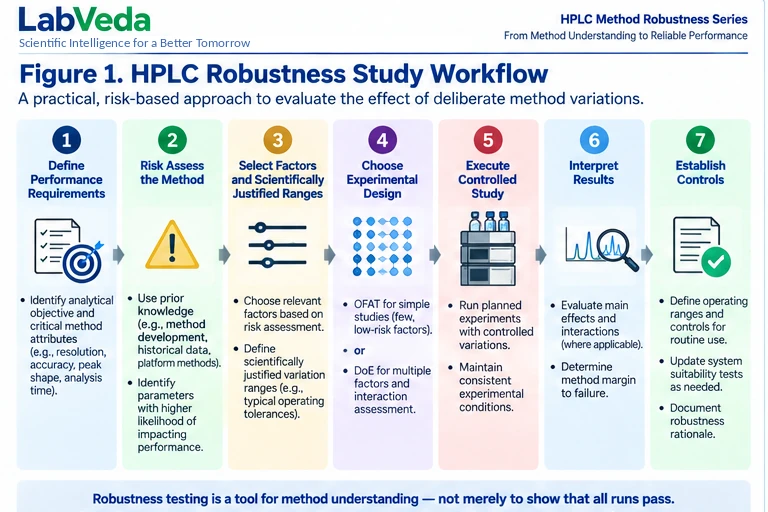
Step 1 — Define the analytical performance responses
Begin with what must remain acceptable, not with a list of instrument settings. The response variables should represent the analytical objective and the failure modes that matter: critical-pair resolution or another selectivity-related response; retention or relative retention where procedure-relevant; peak shape or efficiency where they influence identification, integration or quantitation; assay, impurity result, recovery or another reportable-result attribute; and system-suitability attributes that are mechanistically connected to method performance. A robustness study is weak if it varies many parameters but measures only a convenient response that does not represent analytical performance.
Step 2 — Identify candidate parameters by risk
Use prior knowledge and risk assessment—an Ishikawa diagram, a risk-ranking matrix, prior development data, transfer history, or mechanistic chromatography knowledge—to identify parameters with plausible impact.3 Figure 2 summarizes the parameters most commonly investigated in HPLC and the mechanisms by which each can shift performance.
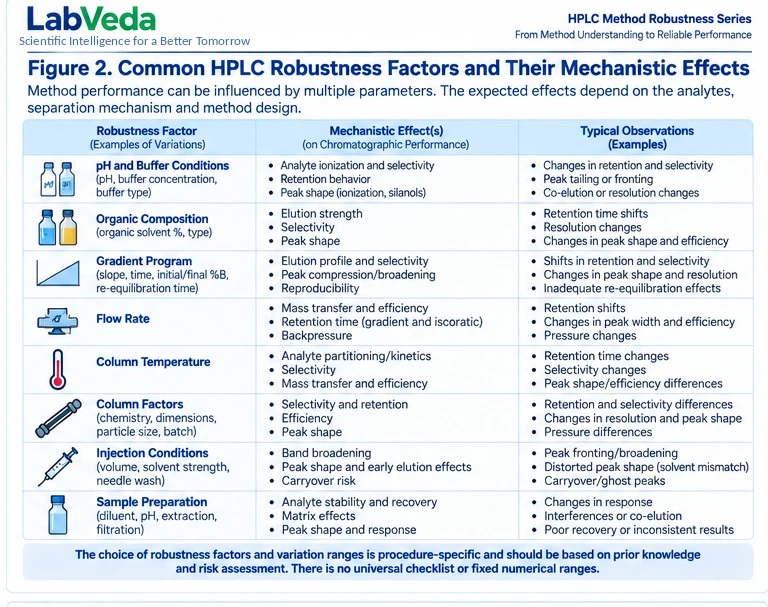
Gradient conditions deserve particular care because gradient time, slope, starting composition and flow are coupled; the interacting variables are treated in the guide on HPLC gradient optimization.
Step 3 — Choose scientifically justified variation ranges
The purpose is to challenge plausible normal-use variability, not to force the method to fail by exploring arbitrary extremes. Ranges should be justified by the controlled procedure, equipment capability, preparation tolerances, development knowledge and expected laboratory practice. Generic values such as ±10% flow, ±5 °C temperature or ±0.2 pH units are not universal robustness ranges; they may be appropriate in a particular study, but their suitability depends on the procedure and the scientific rationale. If a parameter is intentionally explored over a much wider development space, that experiment should be distinguished from a routine-use robustness study.
Step 4 — Select the experimental design
One-factor-at-a-time (OFAT) varies a single factor while holding the others at nominal values. It is easy to understand and can be adequate for a small number of low-risk variables when interactions are scientifically unlikely; its major limitation is that it does not efficiently characterize interactions among factors. A multivariable design of experiments (DoE) can estimate factor effects and, when the design supports it, interactions—particularly valuable when chromatographic variables are mechanistically coupled, such as pH and organic composition, or temperature and selectivity.4 Figure 3 contrasts what each approach can and cannot reveal.
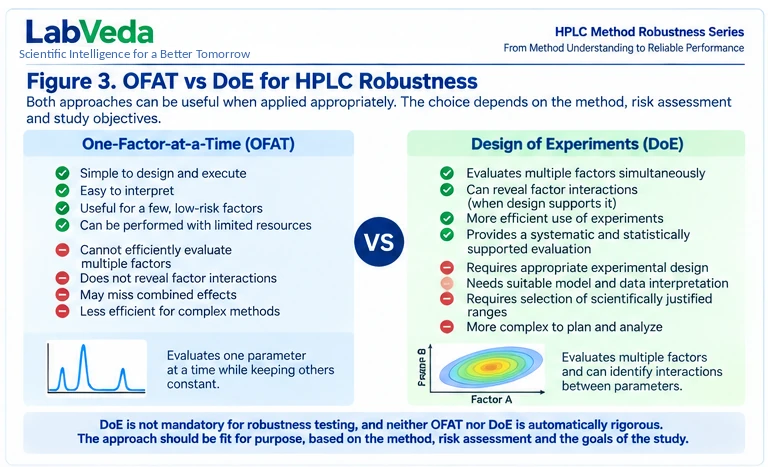
DoE is not automatically superior merely because it is statistical. The design must match the scientific question, the factor ranges, the response behavior and the available resources; a poorly chosen DoE can create false confidence just as easily as an underpowered OFAT study.
Step 5 — Execute the study under controlled conditions
Predefine the factors, levels and ranges, responses and acceptance logic before reviewing outcomes. Use standards and samples capable of revealing relevant failure modes; control non-study variables as far as practical; randomize or block runs where appropriate to reduce confounding from drift or sequence effects; document actual—not merely programmed—conditions where deviations matter; and preserve all runs, including unexpected and failing results, with traceable processing.4 For gradient methods, system characteristics such as gradient delay volume can confound interpretation when experiments move between instruments; robustness should not be used to hide an uncontrolled transfer effect, which is properly addressed as part of HPLC method transfer.
Step 6 — Interpret effects, interactions and margin to failure
Do not reduce the study to ‘all runs passed.’ The objective is to understand sensitivity: which factors have the largest effect on the critical response; whether effects are monotonic, nonlinear or negligible within the studied region; whether factor interactions change the conclusion; how close the nominal method operates to an unacceptable-performance boundary; which variables require tighter control; and which observable system-suitability response could detect a loss of control. A nominal method located near a steep response boundary may technically pass a limited robustness study yet remain operationally fragile, whereas a broad region in which critical responses stay acceptable is stronger evidence of tolerance to normal variability.
Why are HPLC robustness effects often multivariable?
Chromatographic variables are not always independent. A pH change may alter analyte ionization and therefore change how strongly organic composition affects retention; temperature can change selectivity and viscosity simultaneously; gradient slope is coupled to gradient time, composition range, flow and column volume.3 This coupling is the main scientific advantage of a well-designed multivariable study: it can reveal behavior that is invisible when each parameter is varied separately.
Does a robust method have to be insensitive to everything?
No. A chromatographic procedure can be scientifically robust even when certain parameters are critical—provided those parameters are understood and appropriately controlled. The goal is not to demonstrate that nothing matters, but to know what matters, how much it matters within the studied region, and how the procedure will remain in a state of control. This distinction prevents a common mistake: widening ranges until failure occurs and then declaring the method ‘not robust.’ A failure outside the intended operating region may simply define a meaningful boundary.
How do robustness results feed the control strategy?
ICH Q14 explicitly connects risk assessment, parameter understanding and the analytical procedure control strategy, so robustness findings should change how the procedure is controlled.1 Figure 4 traces the path from robustness evidence to routine control.
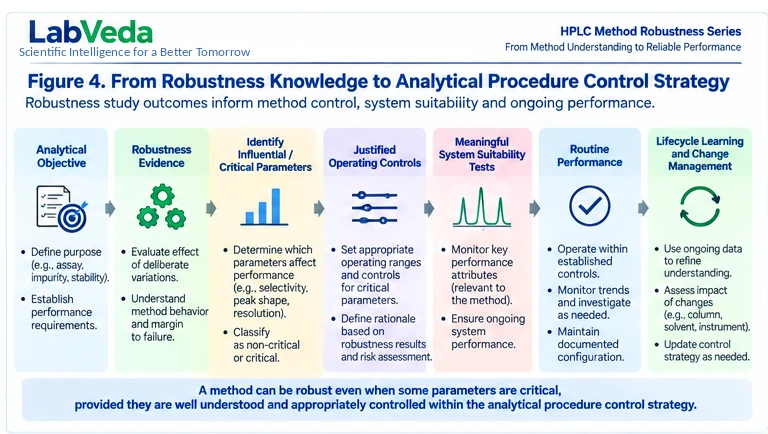
Concretely, robustness findings are used to set or justify operational ranges for influential parameters; specify preparation tolerances where solution composition materially affects performance; define column or system requirements where demonstrated to matter; choose system-suitability parameters that are sensitive to relevant failure modes; document precautions for parameters that require close control; and support scientifically justified lifecycle changes with accumulated method knowledge.5
How do you troubleshoot a failed robustness study?
When a robustness run fails or a response shifts unexpectedly, the pattern of the change usually points to the mechanism. Table 2 maps common observations to their likely interpretation and the next thing to check.
| Observation | Likely interpretation | Check next |
|---|---|---|
| Resolution changes strongly with pH | Selectivity is pH-sensitive | Buffer preparation, pH measurement convention, analyte pKa region, nominal operating point |
| Resolution changes strongly with temperature | Thermodynamic selectivity is temperature-sensitive | Actual column temperature, preheating, thermostatting mode, interaction with composition |
| Gradient changes produce large shifts | Method is sensitive to the programmed or composed gradient | Gradient delay volume, gradient accuracy, gradient slope, starting composition, flow |
| Peak shape worsens with an injection change | Focusing, load or diluent effect | Injection volume, sample solvent strength, sample concentration, initial mobile phase |
| Response changes but chromatography is stable | Detection or sample preparation may dominate | Wavelength and detector settings, standard and sample stability, preparation variables |
| Unexpected curvature or interaction | Response surface is not adequately represented by simple main effects | Design adequacy, additional design points, transformation or model choice, mechanistic explanation |
| Only one anomalous run fails | Possible execution or system event rather than a factor effect | Raw chromatogram, pressure, injection, preparation, instrument logs—do not simply delete the run |
What are the common robustness-study mistakes?
The recurring failures are conceptual rather than technical: using universal parameter ranges without procedure-specific justification; testing many low-value variables while missing the parameter most likely to affect selectivity; using only pass or fail outcomes and ignoring effect magnitude and margin to failure; assuming OFAT can detect interactions; assuming DoE automatically makes a study rigorous; changing factor ranges after viewing results without treating the work as a new experiment; confusing instrument-to-instrument transfer effects with method robustness; using system suitability as the only response when the reportable result may be more informative; and treating a critical parameter as evidence that the whole method is non-robust rather than defining and controlling it.
How does robustness relate to system suitability?
Robustness explains where system-suitability attributes should come from. If robustness studies show that small pH changes cause a critical-pair resolution loss, then critical-pair resolution is a scientifically meaningful candidate for routine system-suitability testing. If a parameter has negligible effect across its justified range, monitoring a surrogate response for it may add little value. The strongest control strategy therefore connects development knowledge to robustness evidence, robustness evidence to parameter controls, parameter controls to system suitability, and system suitability to continued performance.
Frequently asked questions
What is HPLC method robustness?
It is the capacity of an analytical procedure to meet its expected performance requirements during normal use when relevant procedure parameters are deliberately varied within scientifically justified ranges.
Is robustness part of HPLC method validation?
Current ICH Q14 places robustness evaluation primarily during development. If it has already been adequately evaluated during development, it does not need to be repeated during validation; validation data can complement robustness knowledge.
Should I use OFAT or DoE?
It depends on the scientific question. OFAT can be adequate for a few low-risk, independent variables; DoE is more informative when interactions or multivariable effects are plausible. Neither is automatically rigorous, and the design should be fit for purpose.
Which HPLC parameters should be varied?
Only parameters supported by prior knowledge and risk assessment as potentially influential. Common examples include pH, organic composition, flow, temperature, gradient conditions, column-related factors, injection conditions and sample-preparation variables.
What ranges should I use?
Procedure-specific, scientifically justified ranges that represent relevant normal-use variation. There is no universal percentage or temperature range that applies to every method.
Does every robustness run need to pass?
The study is interpreted against its predefined purpose and performance criteria. A failure can be scientifically valuable when it identifies a critical parameter or an operating boundary.
How does robustness relate to system suitability?
Robustness identifies parameter sensitivities and failure modes; that knowledge informs which system-suitability attributes are useful for detecting unacceptable performance during routine use.
The takeaway
An HPLC robustness study is worth running only when it produces method understanding: which parameters matter, how much they matter within a justified range, how close the nominal method sits to a performance boundary, and which controls and system-suitability checks keep the procedure in control. Choose responses that represent the analytical objective, select parameters and ranges by risk rather than from a universal checklist, match the experimental design to the scientific question, and interpret effects and margins rather than a bare pass or fail. Read this way, robustness is the bridge between method development and a defensible control strategy—not a box-ticking exercise near the end of validation.
References
- ICH Q14, Analytical Procedure Development, ICH Harmonised Guideline (Step 4, 2023); adopted as FDA guidance for industry, March 2024.
- ICH Q2(R2), Validation of Analytical Procedures, ICH Harmonised Guideline (Step 4, 2023); adopted as FDA guidance for industry, March 2024.
- LR Snyder, JJ Kirkland, JW Dolan, Introduction to Modern Liquid Chromatography, 3rd ed., Wiley (2010).
- Waters Corporation, Method Robustness Testing Using Empower Method Validation Manager Software Aided by the Empower Sample Set Generator to Automate Method Creation, application note 720007870 (2023).
- Waters Corporation, Accelerated, Automated Development of Robust LC Methods within a QbD Framework, application note (2010).
Further reading
- LR Snyder, JJ Kirkland, JW Dolan, Introduction to Modern Liquid Chromatography, 3rd ed. (2010) — the standard reference for the mechanistic effects underlying HPLC robustness (ref. 3).
- ICH Q14, Analytical Procedure Development (2023) — the primary source for the enhanced, risk-based approach to robustness and the analytical procedure control strategy (ref. 1).
Reviewed against primary sources. Every definition and regulatory statement on this page is checked against ICH Q14 and ICH Q2(R2) and the primary literature cited above. The parameter examples and diagnostic patterns are illustrative of chromatographic behavior and are not method-development predictions or acceptance criteria. For validated or compendial methods, the applicable procedure and regulatory framework take precedence over the general rules of thumb given here. Evidence review: September 2026.