
Do not clean an HPLC column simply because pressure, retention or peak shape changed. First rule out the system, mobile phase, sample, injector, detector and guard column. If the evidence points to the analytical column, choose a cleaning procedure based on the likely contaminant, the stationary-phase chemistry, solvent compatibility and the manufacturer’s current care-and-use instructions. Reverse-flow cleaning is column-specific and is never a universal remedy.
Why does HPLC column cleaning need diagnosis, not a universal recipe?
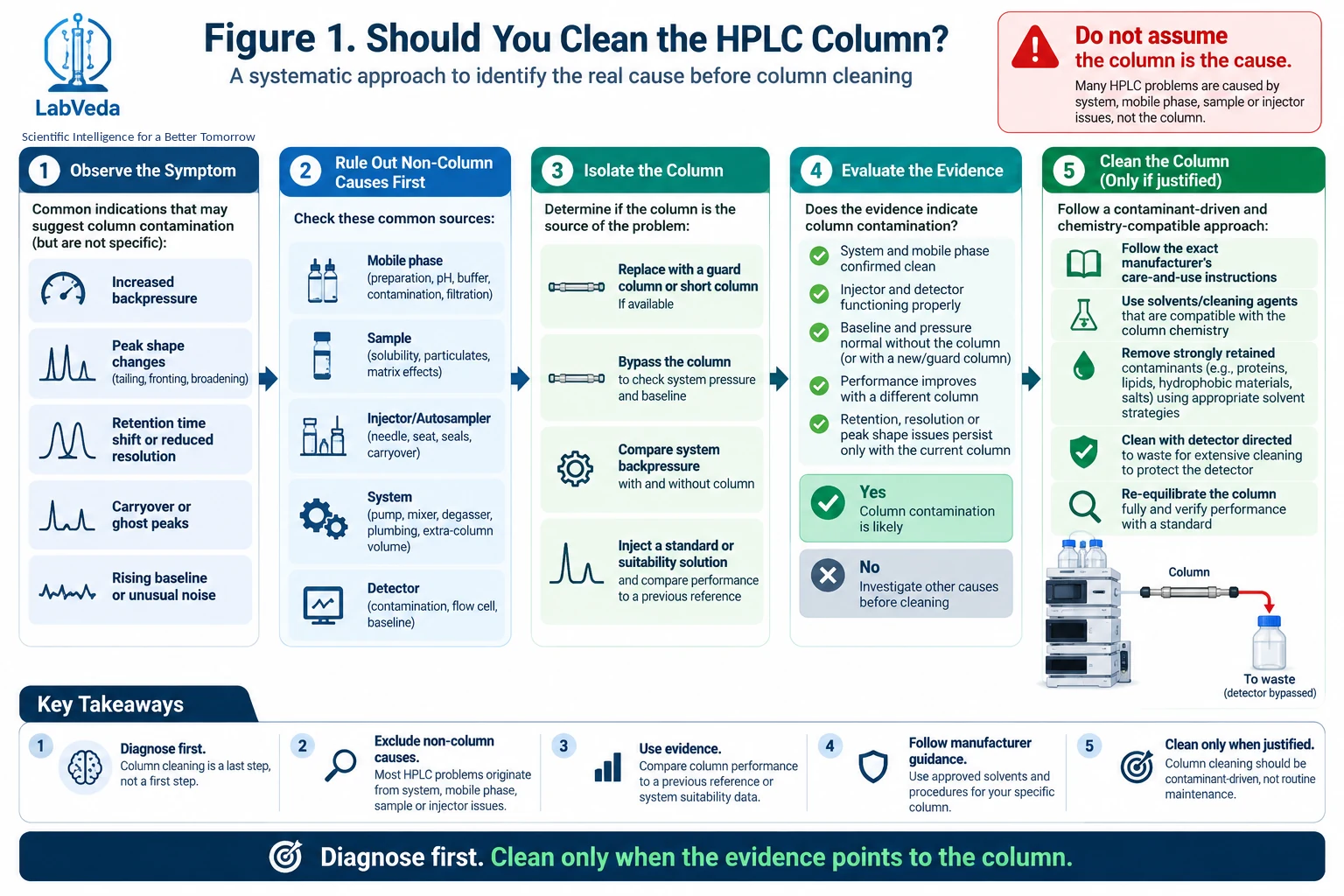
Column contamination can present as increasing backpressure, deteriorating peak shape, changing retention or selectivity, reduced resolution, carryover, ghost peaks or unstable baselines. None of these observations uniquely identifies the analytical column as the source: blocked tubing or frits, contaminated or precipitated mobile phase, injector carryover, detector contamination, sample particulates or an upstream guard device can all produce the same symptoms. Manufacturer guidance is explicit that a cleaning protocol should be selected only after determining what has accumulated on the column, and advises against cleaning when the instrument or mobile phase is the more likely cause.1
The practical objective is therefore not to “wash the column harder.” It is to identify the most likely failure mechanism, isolate the column as the source, select a chemistry-compatible intervention and demonstrate recovery against a defined reference. The care-and-use instructions for the exact column take precedence over generic guidance because the allowable solvents, pH, temperature, pressure, flow direction and cleaning sequences are product-specific.23 Figure 1 sets out that diagnostic-first workflow.
Chromatography Troubleshooting Decision Engine
Any HPLC symptom, one starting point — the engine narrows hundreds of failure modes to the few that fit your evidence.
How do you decide whether the column is actually the problem?
Use symptom patterns rather than a single observation. Compare backpressure with and without the analytical column, and where practical with the guard device removed, so a pressure rise localized to the column or guard assembly can be distinguished from a whole-system rise. Before assigning a peak-shape or resolution change to the column, confirm that mobile-phase composition, pH, buffer preparation, injection solvent, sample load, temperature, fittings and extra-column volume have not changed; the peak-tailing diagnostic path works through those non-column causes. Distinguish directional retention drift from random variation, and check composition delivery, temperature, flow, equilibration and mobile-phase stability first. For carryover or ghost peaks, run appropriate blanks and investigate the injector, needle and seat, sample loop, tubing, mobile phase and detector, following the autosampler carryover workflow before suspecting the column. Table 1 maps the common observations to the first discriminator and the mistake to avoid.
| Observation | First discriminator | If the column is implicated | Do not do first |
|---|---|---|---|
| High backpressure | Compare pressure with and without the column and guard | Investigate inlet frit, particulates or precipitate history; follow product-specific cleaning | Immediately reverse-flow the column |
| Tailing or broadening | Check injection solvent and load, fittings, pH, extra-column effects | Use sample history to identify adsorbed contamination and a compatible cleaning method | Use the strongest available solvent without a compatibility check |
| Retention drift | Check mobile-phase composition, temperature, flow and equilibration | Assess stationary-phase fouling or damage only after system variables are stable | Assume contamination from a retention change alone |
| Ghost peaks or carryover | Run blanks; isolate injector, mobile phase and system | Clean the column only if the blank pattern and isolation support column memory | Clean the column before checking the autosampler |
| Loss of resolution | Check selectivity-driving variables and column history | Compare with a known-good column; clean if fouling is supported | Change method parameters to compensate for a failing column |
A sudden, sustained pressure rise localized to the column is one of the clearer signals; the broader set of pressure causes is covered in the high-backpressure diagnostic path.
How do you identify the likely contaminant before choosing a cleaning method?
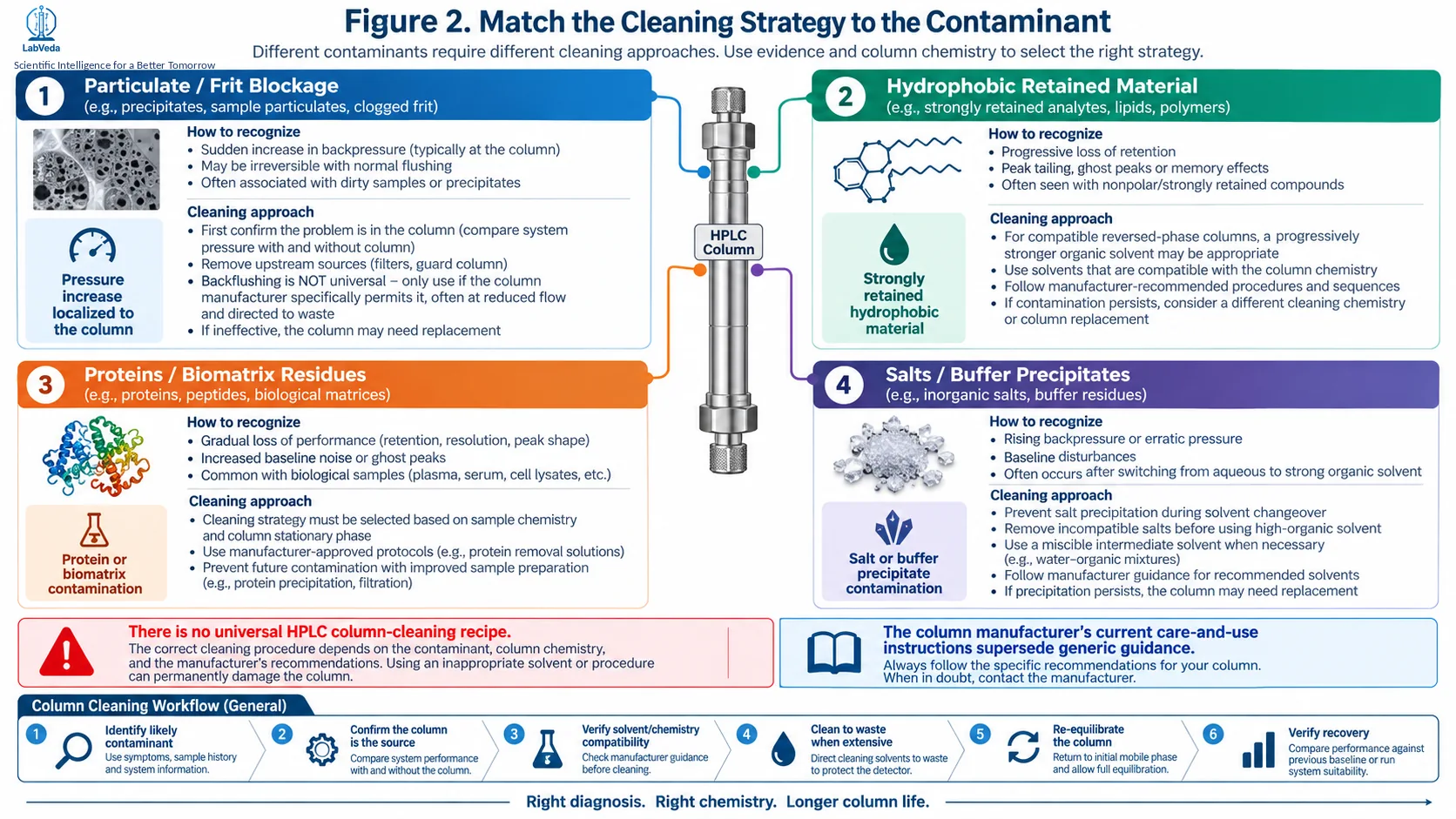
The most effective cleaning solvent is the one that solubilizes or displaces the contaminant without damaging the stationary phase, bonded chemistry, packing bed, frits or instrument. Manufacturer guidance makes this contaminant-dependent: cleaning conditions depend on the sample and excipients injected, and recommendations are separated by particulate matter, hydrophobic contaminants, proteins, metal ions and ion-pairing agents.134 Figure 2 matches the common contaminant classes to the recognition clues and the general cleaning logic, and Table 2 gives the same map in extractable form.
| Likely contaminant | Useful clues | General cleaning logic | Key caution |
|---|---|---|---|
| Particulates / inlet-frit blockage | Pressure increase localized to the column; dirty or precipitating samples | Remove the upstream source; follow product-specific frit or backflush guidance if allowed | Backflushing is not universal; sub-2 µm and specialty columns may prohibit or restrict it |
| Hydrophobic retained material | Progressive memory effects, late-eluting residues, loss of performance with nonpolar matrices | Use a stronger compatible organic environment or the manufacturer sequence | Account for solvent viscosity, pressure, miscibility, detector compatibility and stationary-phase limits |
| Proteins / biomatrix | Biological samples; progressive fouling, peak-shape or recovery changes | Use a chemistry- and product-specific protein-removal or regeneration procedure | Do not assume a generic acid, base, chaotrope or detergent is safe for every column |
| Salts / buffer precipitates | Pressure rise after a solvent change; nonvolatile buffer history | Remove salts with a compatible aqueous or intermediate step before high organic | Do not drive an insoluble salt deeper into the column with an incompatible solvent switch |
| Ion-pairing / strongly adsorbed additives | Persistent retention or selectivity changes after ion-pair use | Extended manufacturer-approved flushing may be required | Some adsorption is difficult to reverse completely; dedicate columns when appropriate |
What is a safe HPLC column-cleaning workflow?
The following sequence is deliberately procedural without prescribing a universal solvent recipe:
- Document the baseline: column identity, history, pressure, chromatogram, system-suitability or test-mixture results, and the symptom that triggered the investigation.
- Exclude non-column causes: mobile phase, solvent compatibility, sample preparation, injector and autosampler, detector, tubing, filters, guard column, fittings, temperature and flow delivery.
- Confirm the column contribution: compare pressure and performance with the column removed, or with a known-good column, where the method and hardware permit.
- Identify the likely contaminant: use sample history, buffer and additive history, solubility, the pressure pattern, chromatographic symptoms and recent method changes.
- Consult the exact care-and-use manual: verify solvent, pH, temperature, pressure, flow-rate, flow-direction and storage restrictions before introducing a cleaning solvent.
- Transition solvents safely: remove incompatible buffers and salts before strong organic solvents, using a mutually miscible intermediate solvent where required to avoid precipitation or phase separation.5
- Clean under controlled conditions: use the manufacturer-recommended sequence and monitor pressure and baseline. For extensive cleaning, manufacturers may recommend directing effluent to waste rather than through the detector.1
- Return to method conditions: re-establish the initial mobile phase through a compatible sequence and equilibrate until the relevant observables are stable.
- Verify recovery: run a standard, test mixture or system-suitability solution and compare pressure, retention, peak shape, efficiency, resolution, baseline and repeatability with the pre-cleaning or historical reference.
- Decide whether to reuse or replace: if cleaning does not restore acceptable performance, avoid repeated, increasingly aggressive treatments without evidence. Permanent stationary-phase damage, packing-bed disturbance, frit blockage or irreversible adsorption may require replacement.
When is reverse-flow (backflush) cleaning appropriate?
Reverse-flow cleaning is one of the most over-generalized pieces of HPLC advice. It is neither universally prohibited nor universally safe. Users should determine whether the specific column chemistry is compatible with reverse flushing, and note the reduced flow that applies when it is.6 Backflushing is permitted for some product families but explicitly excluded for others: columns packed with particles below 1.8 µm should not be backflushed, and particle-size- and product-dependent guidance may specify reduced velocity and flow to waste.23 Specialty columns can carry still different restrictions.7 The rule for practice is simple: use reverse-flow cleaning only when the current manufacturer instructions explicitly permit it for that exact column, and follow the specified flow, solvent, orientation and detector-disconnection precautions.
How does cleaning differ by separation mode?
Cleaning logic is not transferable across separation modes. Table 3 summarizes the typical concern, the cleaning concept and the critical limitation for each mode.
| Mode | Typical concern | Cleaning concept | Critical limitation |
|---|---|---|---|
| Reversed phase (RP) | Hydrophobic residues, matrix components, precipitated buffers, proteins depending on application | Often uses increasingly strong compatible organic conditions or a product-specific sequence; remove incompatible salts before high organic | Do not assume all C18, C8 or phenyl phases share the same pH, solvent, temperature or backflush limits |
| HILIC | Strongly retained polar or ionic material, salts, matrix residues | Cleaning must preserve stationary-phase compatibility and account for high-organic operating environments | Water-rich and salt-containing steps can cause pressure or solubility problems if transitioned improperly |
| Ion exchange | Strongly bound ionic species, proteins, precipitates | May require changes in ionic strength, counter-ion or pH within the product’s permitted range | Generic RP solvent sequences are not transferable to ion exchange |
| SEC / GFC | Proteins, aggregates, nonspecific adsorption, salts | Product-specific salt, organic, pH or denaturant approaches may be allowed | Flow reversal can be restricted or a last resort only; pore chemistry and biomolecule compatibility matter7 |
| Normal phase / polar adsorption | Strongly retained polar material, water contamination | Use a compatible polarity sequence defined for the phase and solvent system | Avoid abrupt switches between immiscible aqueous and nonaqueous solvents; use an intermediate solvent where required5 |
How do you verify that cleaning actually worked?
A visually cleaner chromatogram is not enough. Recovery should be assessed against predefined or historical performance attributes relevant to the method: system and column pressure at the same flow, composition and temperature; retention time or retention factor; peak symmetry and any evidence of splitting or broadening; efficiency using the same peak-width convention; resolution of critical pairs; baseline behavior and detector response; carryover or ghost-peak behavior; and repeatability under the applicable procedure. USP General Chapter ⟨621⟩ describes these system-suitability concepts and common chromatographic parameters, but the acceptance criteria come from the specific analytical procedure or validated framework.8 Where the method is regulated or validated, do not alter it merely to make a deteriorated column pass; cleaning is a maintenance intervention, and analytical acceptance remains governed by the approved procedure. The same performance attributes are the basis of an HPLC system suitability check.
How can you prevent contamination and reduce the need for aggressive cleaning?
Most cleaning is avoidable. Prepare samples to minimize particulates and precipitation, using filtration or centrifugation where analyte recovery allows; use guard columns or in-line filters when compatible with the method’s dispersion and pressure requirements; use high-purity solvents and properly prepared mobile phases, and control microbial growth and buffer age; avoid solvent changes that precipitate nonvolatile salts, flushing salts before introducing an incompatible high-organic solvent; operate within the manufacturer’s pH, pressure, temperature and solvent limits; document column identity, injection history, cleaning events and performance trends so deterioration can be distinguished from a one-off system problem; and consider dedicated columns for difficult matrices or ion-pair methods where cross-use creates a reproducibility risk. These habits are the core of routine HPLC column care and maintenance.
Frequently asked questions
Can I reverse an HPLC column to clean it?
Sometimes, but only if the manufacturer explicitly permits reverse-flow cleaning for that exact column. Guidance differs by particle size, hardware, chemistry and product family, and columns below 1.8 µm are often excluded.
What is the best solvent for cleaning a C18 column?
There is no universal best solvent. The correct choice depends on the contaminant, the bonded phase and support, the column’s solvent and pH limits, and the manufacturer’s cleaning sequence.
Should I disconnect the detector during cleaning?
For extensive cleaning, directing column effluent to waste is commonly recommended to protect the detector from concentrated contaminants or aggressive cleaning solvents, but follow the instrument and column instructions.
How many column volumes should I flush?
There is no universal number that applies to every column and contaminant. Manufacturer procedures may specify column volumes, time or performance endpoints; use the exact care-and-use manual rather than a generic value.
How do I know when cleaning has failed?
If the column remains the confirmed source and a permitted cleaning procedure does not restore pressure and chromatographic performance to an acceptable reference, further aggressive cleaning is usually counterproductive. Consider irreversible damage or replacement.
Can cleaning restore a chemically damaged stationary phase?
No. Cleaning can remove reversible contamination; it cannot reliably reverse hydrolysis, ligand loss, packing-bed disturbance, frit damage or other permanent deterioration.
The takeaway
HPLC column cleaning is a diagnosis, not a reflex. Rule out the system, mobile phase, sample, injector, detector and guard column before touching the column; identify the likely contaminant; consult the exact care-and-use manual; clean with compatible conditions; re-equilibrate; and verify recovery against a defined reference. Treat reverse-flow cleaning as column-specific, never as a default, and remember that cleaning removes reversible contamination but cannot undo permanent damage. Done this way, cleaning restores performance and extends column life instead of quietly destroying a column that was never the real problem.
References
- Waters Corporation, What are general tips for column cleaning?, Knowledge Base WKB23409 (accessed September 2026).
- Agilent Technologies, Reversed-Phase Columns User Guide — cleaning and backflush guidance, incl. the restriction on backflushing sub-1.8 µm columns (current edition, accessed September 2026).
- Thermo Fisher Scientific, Column care guide and general method-development information for hydrophobic columns, document FL000962 (accessed September 2026).
- Waters Corporation, Recommended conditions for cleaning XSelect / ACQUITY CSH C18 columns, Knowledge Base WKB204454 and WKB71611 (accessed September 2026).
- Waters Corporation, Converting a Spherisorb Cyano normal-phase column to reversed-phase operation (solvent-changeover guidance), Knowledge Base WKB84238 (accessed September 2026).
- Waters Corporation, Can I clean my Waters column in the reverse direction of the flow arrow?, Knowledge Base WKB32312 (accessed September 2026).
- Waters Corporation, Cleaning ACQUITY / XBridge BEH SEC columns and reverse-flow considerations, Knowledge Base WKB70819 and WKB121919 (accessed September 2026).
- United States Pharmacopeia, General Chapter ⟨621⟩ Chromatography, USP-NF (current applicable edition).
Further reading
- The manufacturer’s current care-and-use manual for your exact column — the authoritative source for permitted solvents, pH, temperature, pressure and flow direction (refs. 1–7).
- LabVeda, HPLC column care and maintenance — routine practices that prevent the contamination cleaning is meant to reverse.
Reviewed against primary sources. Every operating principle on this page is checked against current manufacturer care-and-use guidance and USP General Chapter ⟨621⟩. Manufacturer-specific operating limits were deliberately not generalized, numerical cleaning conditions are not presented as universal, and reverse-flow guidance is explicitly product-specific. For validated or compendial methods, the applicable procedure and regulatory framework take precedence over the general rules of thumb given here. Evidence review: September 2026.