
HPLC column care is the set of preventive practices that keep the packed bed, the inlet frit and the stationary phase in the state that produced the method’s original chromatography: clean samples and mobile phases, operation inside the column’s pH, pressure and temperature limits, evidence-based equilibration, trended performance monitoring, cleaning only when indicated and chemistry-specific storage.
Operating, cleaning and storage limits are specific to the column chemistry and product, so the manufacturer’s current care-and-use instructions take precedence over the general rules given here.
Why does HPLC column care matter?
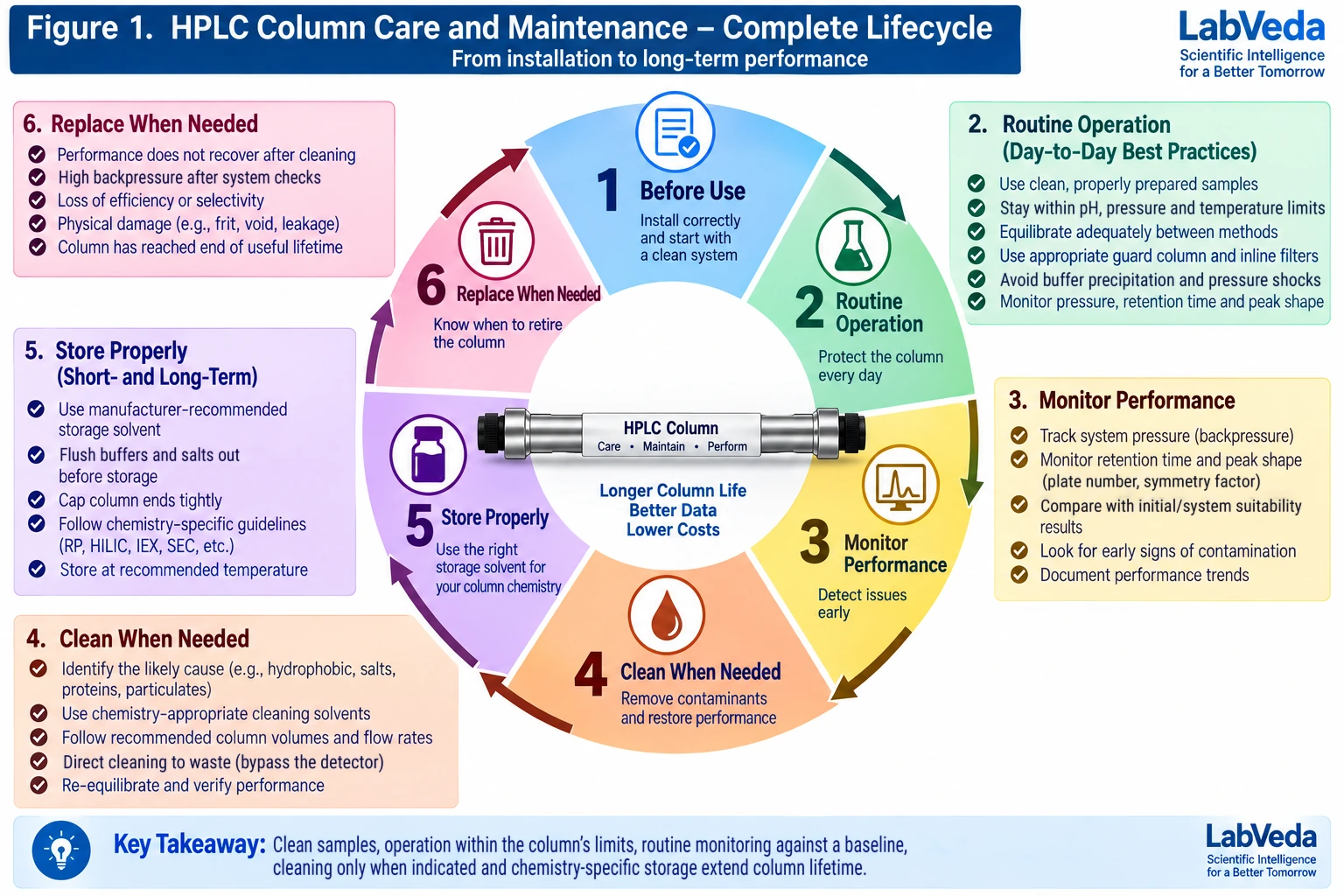
Column performance reflects every sample, solvent, buffer, pressure excursion and storage condition the column has seen. Deterioration appears as rising pressure, loss of plate number, altered selectivity, retention drift, tailing or broadening and declining resolution. None of these is proof of column failure on its own, because contamination or dispersion elsewhere in the flow path produces the same symptoms. Figure 1 summarizes the six stages of column care.
Chromatography Troubleshooting Decision Engine
Any HPLC symptom, one starting point — the engine narrows hundreds of failure modes to the few that fit your evidence.
How do you establish an HPLC column performance baseline?
When a new column is installed, or a method is transferred to a replacement column, record its performance under defined conditions with a stable test mixture or the method’s system-suitability standard. Record the column identity (dimensions, stationary phase, particle size, serial and lot numbers) and the conditions, because a baseline is comparable only under the conditions that produced it. Table 1 lists the quantities worth trending. Plate number and symmetry factor follow the harmonized definitions of United States Pharmacopeia (USP) General Chapter ⟨621⟩:1
N = 5.54 (tR / wh)2
As = w0.05 / (2d)
where tR is the retention time, wh the peak width at half height, w0.05 the width at 5% of peak height and d the distance from the leading edge to the perpendicular from the peak maximum at 5% height. Unless the monograph states otherwise, USP ⟨621⟩ requires a symmetry factor of 0.8–1.8 for the peak used for quantification in assay and related-substances tests.1 Trend the values: a single noisy injection is not a change, and a sudden step usually has a different root cause from a slow decline.
| Quantity | How it is recorded | A change points to |
|---|---|---|
| Retention time tR (or retention factor k) | Test mixture under fixed composition, flow and temperature | Mobile-phase, temperature or flow error first; then surface contamination or phase loss |
| Plate number N | Half-height method, USP ⟨621⟩ | Bed or frit damage, fouling, added extra-column volume |
| Symmetry factor As | w0.05/(2d), USP ⟨621⟩ | Active sites, partially blocked frit, void, overload |
| Resolution Rs of the critical pair | System-suitability injection | Combined loss of efficiency, selectivity or retention |
| Pressure | At stated flow, composition and temperature | Particulates on a frit, precipitate, blocked tubing |
| Blank baseline | Blank gradient or blank injection | Retained contamination or carryover |
How do you protect the HPLC column inlet from particulates and strong sample solvents?
Pressure rises as particulate matter accumulates on the inlet frit, and the first frit after the autosampler is the most common place for debris from samples to collect.2,3 Three controls address it: filter or centrifuge samples where the method and analyte allow; fit an in-line filter downstream of the autosampler, with a 0.5 µm frit for columns packed with particles larger than 2 µm and a 0.2 µm frit for columns of 2 µm or smaller particles;3 and use a guard column, a miniature column containing similar packing, when the matrix carries strongly retained material.2,4 Guards and filters are themselves consumables; a guard-column lifetime of 50–100 samples or more is a reasonable expectation.2 When pressure does rise, the HPLC backpressure diagnosis guide gives the sequence for isolating the restriction.
Sample solvent matters as well. A sample dissolved in a solvent stronger than the mobile phase is swept along the column before it is retained, which broadens peaks, and a viscosity mismatch between the sample plug and the mobile phase distorts early-eluting bands.5,6 Both can look like a failing column when the column is healthy.
What pH, pressure and temperature limits protect an HPLC column?
Silica-based, hybrid, polymeric, ion-exchange, size-exclusion and specialty phases differ materially, and the specification for the exact chemistry and dimensions controls. For conventional silica-based bonded phases the customary working range is pH 2–8, or pH 2.5–7.5 to be conservative.2 Below about pH 2 the silyl ether bond that anchors the bonded phase can be hydrolyzed, and the gradual loss of bonded phase shows as falling retention.7 Above pH 8 the failure mechanism is mainly dissolution of the silica support;8 it is strongly accelerated by temperature, and at pH 10 carbonate and phosphate buffers degraded packings much faster than borate or glycine buffers.9 Some endcapped silica columns tolerate pH 11 with organic buffers at 40 °C or below,10 which is why the manufacturer’s range for the specific product is the limit to apply.
Temperature should be controlled, not merely recorded: as a rule of thumb for small molecules, reversed-phase retention changes by about 2% per 1 °C, selectivity can change with it, and pressure falls as temperature rises because mobile-phase viscosity falls.11,12,13 Buffer salts precipitate when the organic fraction rises too far. In one set of measurements, 30 mM potassium phosphate at pH 3 stayed in solution only below 75% acetonitrile,14 so change between buffered and high-organic conditions through a miscible, buffer-free intermediate. Voids form through chemical attack on the particles or severe mechanical abuse and cannot be repaired;15 as a working rule, raise the flow gradually after storage or a major solvent change and stay below the rated pressure. Conventional C18 phases also dewet in fully aqueous mobile phase: the eluent is extruded from the pores and retention falls gradually or suddenly, most markedly after the flow is stopped, and flushing with 50:50 acetonitrile–water restores it.16
How long should an HPLC column be equilibrated?
Equilibration is complete when pressure, baseline and retention are stable to the method’s criteria, not when a fixed volume has passed. Volumes are still the practical unit, and the column hold-up volume VM can be estimated from the dimensions:17
VM ≈ 0.5 × L × dc2 / 1000
with VM in mL (an estimate for fully porous particles) and the length L and internal diameter dc in mm (measuring it is covered in the column void volume guide). For a 150 × 4.6 mm column, VM ≈ 0.5 × 150 × 4.62 / 1000 = 1.6 mL; for 50 × 2.1 mm it is 0.11 mL. After installation or storage, the usual working rule for reversed-phase columns is 10–20 column volumes of mobile phase,18 which is 16–32 mL, or 16–32 min at 1.0 mL/min, for the 150 × 4.6 mm column. Between gradient runs far less can suffice: retention repeatable to ±0.002 min has been shown with at most 2 column volumes, even though full equilibration can need considerably more than 20.19 Ion-pairing methods need much longer.
Hydrophilic interaction chromatography (HILIC) is slower to reach full equilibrium. Full equilibration could take up to an hour, depending on the stationary phase, the storage solvent and the flow rate, while a repeatable partial equilibration was reached in about 5 min after two conditioning runs.20 Ion-exchange methods likewise need conditioning until retention is stable. Unexplained drift after a solvent change is treated in the retention time drift guide.
Which signals show that HPLC column performance is declining?
Table 2 pairs each observed change with its possible column-related cause and with the system checks to make first. A problem that arises before the sample is separated, such as a partially blocked inlet frit or a void, affects every peak in the chromatogram in the same way, whereas a chemical cause affects some analytes more than others.15,21
| Observed change | Possible column-related cause | System checks to make first |
|---|---|---|
| Pressure increases | Inlet-frit loading, precipitate, fouling | Check tubing, injector, guard column or filter and mobile phase; measure the pressure without the column |
| Retention changes | Surface contamination, stationary-phase loss | Verify mobile-phase composition, pH, flow, temperature, dwell volume and equilibration |
| Peak tailing or broadening | Fouling, active sites, bed damage | Check injection solvent, overload, extra-column volume, fittings and detector cell; see the HPLC peak shape troubleshooting guide |
| Resolution declines | Loss of efficiency or selectivity | Compare plate number, retention and separation factor with the system-suitability history |
| Ghost peaks or baseline changes | Retained contamination eluting late | Run blanks to decide whether the source is the injector, the solvent, the system or the column |
When does routine HPLC column care become column cleaning?
Cleaning is indicated when the trend shows that recoverable contamination has accumulated and the system checks in Table 2 do not explain the change. The solvent is chosen for the suspected contaminant and must be compatible with the stationary phase, and extended washes are directed to waste, not through the detector. Solvent sequences for each column chemistry are given in the HPLC column cleaning procedure.
How should an HPLC column be stored?
Storage has three aims: to preserve the stationary phase and the packed bed, to prevent precipitation and microbial growth and to keep the bed from drying. Before storage, flush the buffer out with about 10 column volumes of roughly 10% organic solvent in water and only then move to the storage solvent.14 Reversed-phase columns are most often stored in mixed organic–water; for ion-exchange columns stored in aqueous solution, about 10% organic solvent or a low concentration of sodium azide (for example 0.05%) suppresses microbial growth.14 Size-exclusion, affinity and other biomolecule columns likewise follow the aqueous storage buffer and preservative named in their care instructions. For a pause of 2–4 days, leaving the column in the mobile phase is generally tolerable.14 Seal both ends with the end plugs14,18 and record the storage solvent and the date. On reuse, move to the mobile phase through a miscible transition, re-equilibrate and check performance against the baseline before critical work.
When should an HPLC column be replaced?
Replacement is reasonable when a verified column problem persists after an appropriate, chemistry-compatible cleaning; when selectivity or efficiency has changed irreversibly; when pressure stays abnormal after inlet and system causes are excluded; or when the bed, a frit or the hardware is physically damaged. The practical criterion is the method’s own system suitability: a column that can no longer meet it after cleaning should be retired, and one poor chromatogram is not evidence of that.
What does an HPLC column maintenance checklist look like?
Table 3 lists the actions at each of the six stages of Figure 1, with the record that each stage leaves in the column log.
| Stage | Actions | Log entry |
|---|---|---|
| 1. Before use | Install on a clean, flushed system; record the baseline (Table 1) | Column identity, conditions, baseline values |
| 2. Routine operation | Clean samples and mobile phases; guard column or in-line filter; operation inside the column’s limits; no buffer precipitation; equilibration to stable retention | Method, injections run, guard or filter changes |
| 3. Monitor performance | Trend the Table 1 quantities; rule out system causes first (Table 2) | System-suitability results |
| 4. Clean when needed | Clean only on evidence of recoverable contamination, to waste; re-equilibrate and re-test | Trigger, procedure, result |
| 5. Store properly | Flush buffers out; storage solvent per the column chemistry; end plugs fitted | Storage solvent and date |
| 6. Replace when needed | Retire the column when system suitability cannot be recovered or the bed is damaged | Reason and injection count |
Frequently asked questions
Should every HPLC mobile phase be filtered?
Not necessarily. The purpose is to keep particulates and insoluble material out of the pump and the column without introducing contamination, so as a working rule filtration matters most for mobile phases made up in the laboratory from solid buffer salts and least for solvents supplied pre-filtered; the method’s own instruction governs. The larger risk with aqueous buffers is microbial growth in highly aqueous mobile phases: one practitioner recommendation is to replace buffers at least weekly and organic-based mobile-phase components at least monthly.22 Flushing the system with nonbuffered solvent before shutdown removes buffer residues.2
Can a reversed-phase HPLC column be stored in 100% acetonitrile?
Some manufacturers specify it, but mixed organic–water storage is the more common instruction; in one informal survey of about 30 reversed-phase column care sheets, about 65% recommended 50:50 to 80:20 organic–water.14 The risk with any high-organic storage solvent is residual buffer, which can precipitate in the bed when a column goes directly from phosphate buffer to acetonitrile. The care-and-use manual for the specific column decides.
Is high backpressure always an HPLC column problem?
No. Tubing, injector components, in-line filters, guard columns, precipitated buffer and detector plumbing all contribute to system pressure. Loosen fittings progressively, or remove components one at a time, until the pressure step is located.3 Only a restriction that stays with the analytical column is a column problem, and even then the usual site is the inlet frit, not the packed bed.2,3
Can an HPLC column be reverse-flushed?
Only where the manufacturer permits it for that column. If the inlet frit has a higher porosity than the outlet frit, reversing the flow can flush packing out of the column.23 Most columns packed with 5 µm particles can be reverse-flushed, while sub-2 µm and other formats depend on the frit design, and the technique clears a blocked frit only about one-third of the time.15 The procedure is to reverse the column and pump 10–20 column volumes of mobile phase (about 15–30 mL for a 150 × 4.6 mm column) directly to waste.15
How many injections should an HPLC column last?
Lifetimes of 500 to more than 2,000 injections are common;15 at least 500 is expected even under severe mobile-phase conditions24 and about 500 has been proposed as the break-even point at which a column has repaid its cost.25 These are practitioner figures, not specifications: lifetime depends on the matrix, the pH and temperature of the method and the inlet protection in place. A recorded injection count lets a laboratory set its own expectation and see when a change in sample preparation or guard-column practice has shortened or extended it.
The takeaway
HPLC column care is mostly prevention and record-keeping. With a baseline recorded at installation and a trend of pressure, retention, plate number and symmetry, a change can be assigned to the system or to the column before anything is cleaned, stored or discarded, and cleaning, storage and replacement become decisions made on evidence. Because a sound method places fewer demands on the column in the first place, the same thinking starts in HPLC method development.
Tracking a column’s performance over time? A free LabVeda account saves your diagnostics, method-development sessions and exports and carries them across visits – the Knowledge Hub and tools stay open to everyone.
References
- United States Pharmacopeia, General Chapter ⟨621⟩ Chromatography, USP–NF, harmonized text official 1 December 2022 (peak-symmetry and system-sensitivity subsections official 1 May 2025); document M99380.
- J. W. Dolan, “Extending Column Life”, LCGC North America 23(11), 1174–1181 (2005).
- J. W. Dolan, “Troubleshooting Basics, Part II: Pressure Problems”, LCGC North America 29(9) (2011).
- J. W. Dolan, “Column Protection: Three Easy Steps”, LCGC Europe 27(12), 640–644 (2014).
- J. W. Dolan and B. Alsehli, “The Role of the Injection Solvent”, LCGC Europe 25(10) (2012).
- S. Keunchkarian, M. Reta, L. Romero and C. Castells, “Effect of sample solvent on the chromatographic peak shape of analytes eluted under reversed-phase liquid chromatographic conditions”, Journal of Chromatography A 1119(1–2), 20–28 (2006).
- J. W. Dolan, “Detective Work, Part IV: Chemical Problems with the Column: Chemical Attack”, LCGC North America 34(2) (2016).
- J. J. Kirkland, M. A. van Straten and H. A. Claessens, “High pH mobile phase effects on silica-based reversed-phase high-performance liquid chromatographic columns”, Journal of Chromatography A 691(1–2), 3–19 (1995).
- H. A. Claessens, M. A. van Straten and J. J. Kirkland, “Effect of buffers on silica-based column stability in reversed-phase high-performance liquid chromatography”, Journal of Chromatography A 728(1–2), 259–270 (1996).
- J. J. Kirkland, J. W. Henderson, J. J. DeStefano, M. A. van Straten and H. A. Claessens, “Stability of silica-based, endcapped columns with pH 7 and 11 mobile phases for reversed-phase high-performance liquid chromatography”, Journal of Chromatography A 762(1–2), 97–112 (1997).
- J. W. Dolan, “How Much Retention Time Variation Is Normal?”, LCGC North America 32(8) (2014).
- J. W. Dolan, “Temperature selectivity in reversed-phase high performance liquid chromatography”, Journal of Chromatography A 965(1–2), 195–205 (2002).
- R. E. Majors, “Column Pressure Considerations in Analytical HPLC”, LCGC North America 25(11) (2007).
- D. R. Stoll, “Column Care for the Long Haul – Considerations for Column Storage”, LCGC North America 35(7) (2017).
- J. W. Dolan, “Detective Work, Part II: Physical Problems with the Column”, LCGC North America 33(12), 894–899 (2015).
- D. R. Stoll, “Reversed-Phase Liquid Chromatography and Water, Part I: How Much is Too Much?”, LCGC North America 37(2) (2019).
- J. W. Dolan, “Column Dead Time as a Diagnostic Tool”, LCGC North America 32(1) (2014).
- J. W. Dolan, “Column Care”, LCGC North America 26(8) (2008).
- A. P. Schellinger, D. R. Stoll and P. W. Carr, “High speed gradient elution reversed-phase liquid chromatography”, Journal of Chromatography A 1064(2), 143–156 (2005).
- D. V. McCalley, “A study of column equilibration time in hydrophilic interaction chromatography”, Journal of Chromatography A 1554, 61–70 (2018).
- J. W. Dolan, “Troubleshooting Basics, Part IV: Peak Shape Problems”, LCGC North America 30(7) (2012).
- J. W. Dolan, “Troubleshooting Basics, Part III: Retention Problems”, LCGC North America 29(12) (2011).
- R. E. Majors, “The Top 10 HPLC and UHPLC Column Myths: Part 2”, LCGC Europe 26(11) (2013).
- J. W. Dolan, “A Baker’s Dozen”, LCGC North America 23(9), 1008–1012 (2005).
- J. W. Dolan, “LC Column Problems Everywhere”, LCGC Europe 28(9) (2015).
Further reading
- L. R. Snyder, J. J. Kirkland and J. W. Dolan, Introduction to Modern Liquid Chromatography, 3rd ed., Wiley (2010). DOI: 10.1002/9780470508183.
- U. D. Neue, HPLC Columns: Theory, Technology, and Practice, Wiley-VCH (1997).
- J. W. Dolan and L. R. Snyder, Troubleshooting LC Systems, Humana Press (1989). DOI: 10.1007/978-1-59259-640-9.
Reviewed against primary sources. Every definition, limit and working rule on this page is checked against USP General Chapter ⟨621⟩ and the primary and practitioner literature cited above. Numerical examples are illustrative calculations from the equations stated and are not acceptance criteria. For validated or compendial methods, the applicable procedure and regulatory framework take precedence over the general rules of thumb given here. Evidence review: September 2026.