
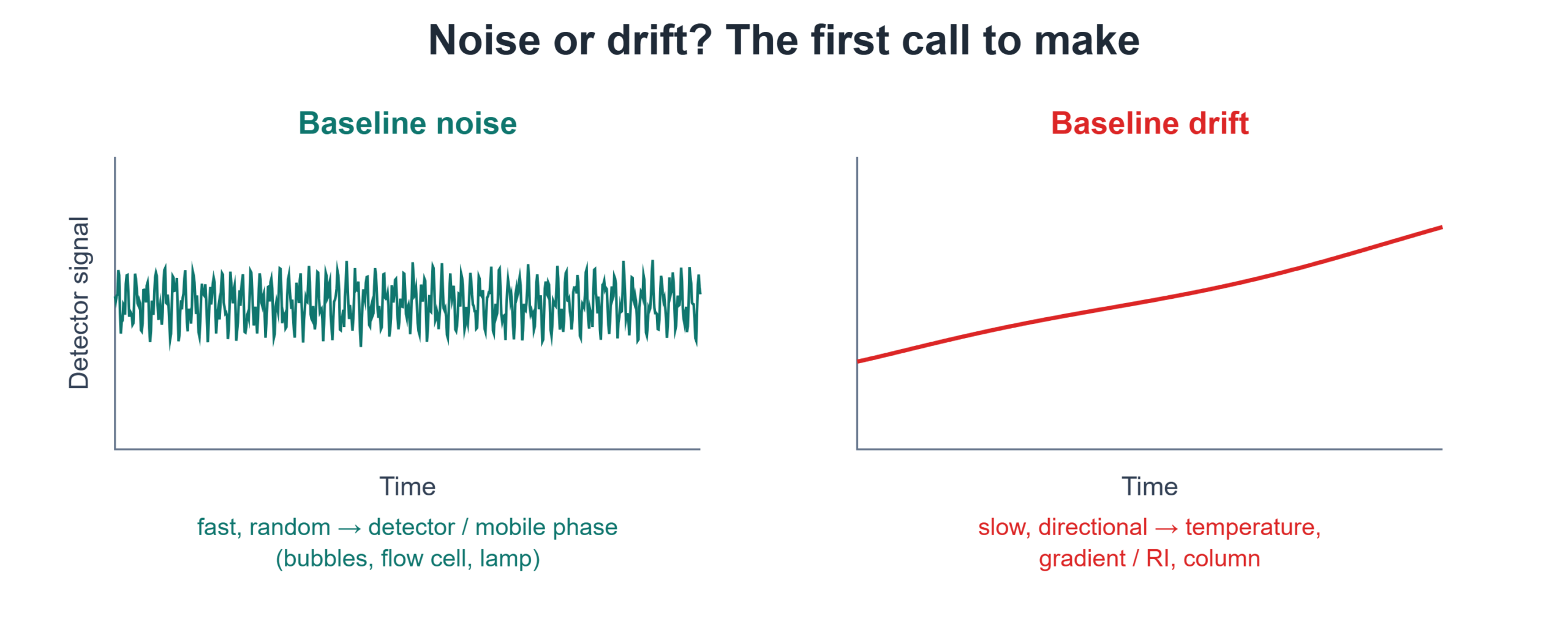
An unstable baseline is one of the most common and most time-consuming problems in HPLC. Figure 1 contrasts the two. A wandering or fuzzy baseline masks low-level peaks, degrades your signal-to-noise ratio, and quietly pushes up your detection limits. But “my baseline looks bad” isn’t a diagnosis — and the fastest way to fix it is to first recognize which of two very different problems you’re looking at.
The one distinction that sorts everything: noise or drift?
Almost every baseline problem falls into one of two categories, and they point to completely different causes:
- Baseline noise is rapid, random, short-term fluctuation — high-frequency jitter, small up-and-down movements unrelated to any peak. It usually comes from the detector or the mobile phase.
- Baseline drift is a slow, directional shift over a run or a sequence — a gradual rise or fall, a low-frequency wander. It usually comes from temperature, mobile-phase changes, or the column.
Before touching anything, classify what you see. Fast and random means noise; slow and directional means drift. That single call sends you down the right branch — so we’ll take them in turn.
Chromatography Troubleshooting Decision Engine
Any HPLC symptom, one starting point — the engine narrows hundreds of failure modes to the few that fit your evidence.
Baseline noise: usually the detector or mobile phase
Noise is high-frequency, so look first at the two things that change fast: what’s flowing through the flow cell, and the detector itself.
Dissolved gas and bubbles. The single most common cause. Poorly degassed mobile phase releases microbubbles that scatter light in a UV flow cell, producing spikes and jitter. Confirm your online or vacuum degasser is working, and degas fresh mobile phase properly before use.
Contaminated or UV-active solvents. Impurities in solvents and additives create spurious signal. Old or degraded TFA and THF are notorious for raising noise (and drift). Use fresh, high-purity solvents and handle UV-active additives carefully.
A dirty flow cell or a bubble in it. A trapped bubble produces sharp, erratic spikes; a fouled cell adds general noise. Flush the cell, and if spikes persist, briefly back-pressure the detector to clear the bubble.
A weak or aging UV lamp. As a deuterium lamp ages it dims, which raises noise and lowers sensitivity. Most systems have a lamp-intensity diagnostic — run it, and replace the lamp if output is low.
Pump and electronics. A failing check valve or worn seal causes flow ripple that shows up as periodic noise; electrical interference and poor grounding add their own patterns. If the noise is periodic and tracks the pump stroke, suspect the pump.
Baseline drift: usually temperature, mobile phase, or column
Drift is low-frequency, so look at the things that change slowly over a run.
Temperature. The most common cause of drift. Detector and column temperature affect refractive index and response; an unstable column oven or a lab with swinging ambient temperature produces a slow wander. Make sure the oven is on, at setpoint, and equilibrated, and keep the detector out of drafts and direct sun.
Mobile-phase and gradient effects. In gradient methods, the refractive index and UV absorbance of the mobile phase change as composition changes, producing a characteristic drift across the gradient. Additives like TFA absorb UV and can raise the baseline run over run as they degrade. Match your solvents’ UV cutoffs to your detection wavelength and keep additives fresh.
Column equilibration and bleed. A column that hasn’t fully equilibrated will drift until it settles; an old column can “bleed” stationary phase, causing a persistent rise. Give new methods adequate equilibration, and retire columns that bleed.
A dirty flow cell. Contamination in the cell causes drift as well as noise — another reason to keep it clean.
A diagnostic flow you can follow
- Classify the pattern — fast and random (noise) vs. slow and directional (drift).
- For noise: check degassing and bubbles first, then the flow cell, then the lamp, then the pump and electronics.
- For drift: check temperature stability first, then the mobile phase and gradient, then column equilibration and bleed.
- Stop the flow briefly — if the disturbance persists with no flow, it’s electronic or lamp-related, not flow-related.
- Swap in fresh, high-purity mobile phase to rule out solvent contamination in a single injection.
The takeaway
A bad baseline feels like a detector failure, but it rarely is. The single most useful move is to classify the disturbance: high-frequency noise points to the detector and mobile phase — bubbles, solvents, flow cell, lamp — while low-frequency drift points to temperature, gradient and refractive-index effects, and the column. Make that one call first, and a wandering baseline turns into a short, targeted checklist.
Related troubleshooting guides: Ghost peaks in HPLC and Drifting HPLC peak retention times.
Not sure whether you’re chasing noise or drift? LabVeda’s Chromatography Troubleshooting Decision Engine walks you through the classification and the fix.