Method Basics

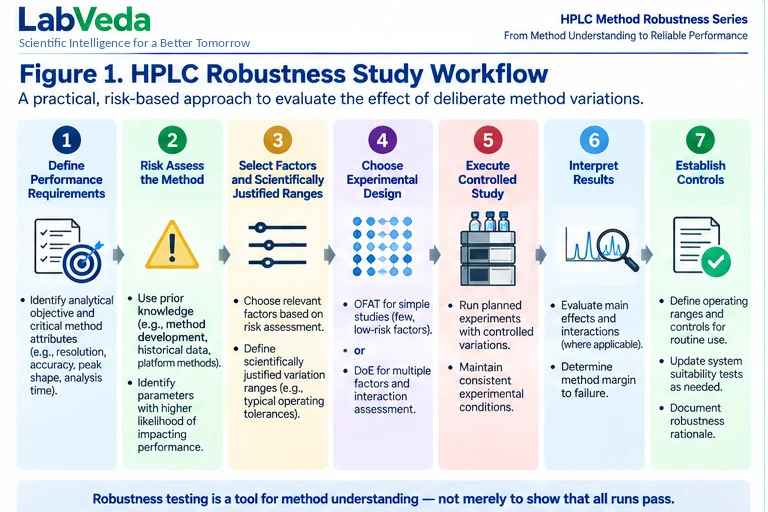
HPLC method robustness study workflow: define performance requirements, risk-assess the method, select factors and justified ranges, choose experimental design, execute controlled study, interpret results, establish controls

HPLC Method Robustness Testing: Parameters, Experimental Design and Interpretation

HPLC method robustness is the capacity of an analytical procedure to meet its expected performance requirements during normal use when procedure parameters are varied deliberately within scientifically justified ranges. Under ICH Q14, robustness is evaluated by deliberate variation of procedure parameters, guided by prior knowledge and risk assessment. A useful robustness study does more than …

HPLC Method Robustness Testing: Parameters, Experimental Design and Interpretation Read More »

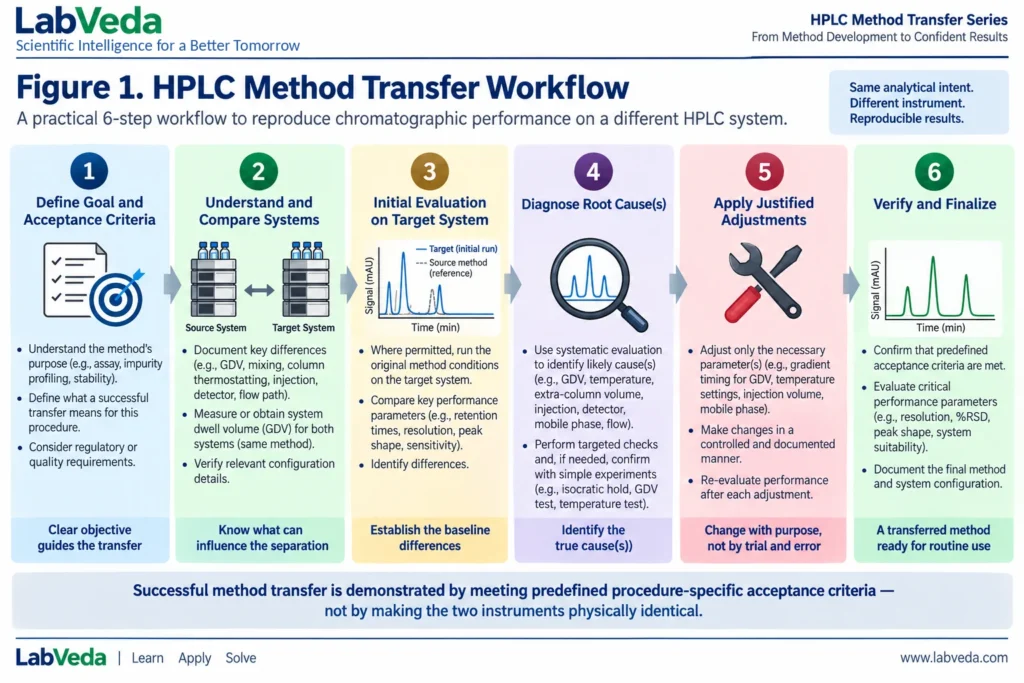
A six-step HPLC method transfer workflow: define the goal and acceptance criteria, understand and compare the source and target systems, run an initial evaluation on the target, diagnose root causes, apply justified adjustments, and verify and finalize.

HPLC Method Transfer Between Instruments: A Practical Guide to Reproducing Chromatographic Performance

HPLC method transfer is the controlled process of moving an analytical procedure from one instrument, laboratory or LC platform to another while demonstrating that the receiving system meets predefined transfer acceptance criteria. The central question is not whether the two instruments are physically identical; it is whether the target system reproduces the analytical performance the …

HPLC Method Transfer Between Instruments: A Practical Guide to Reproducing Chromatographic Performance Read More »

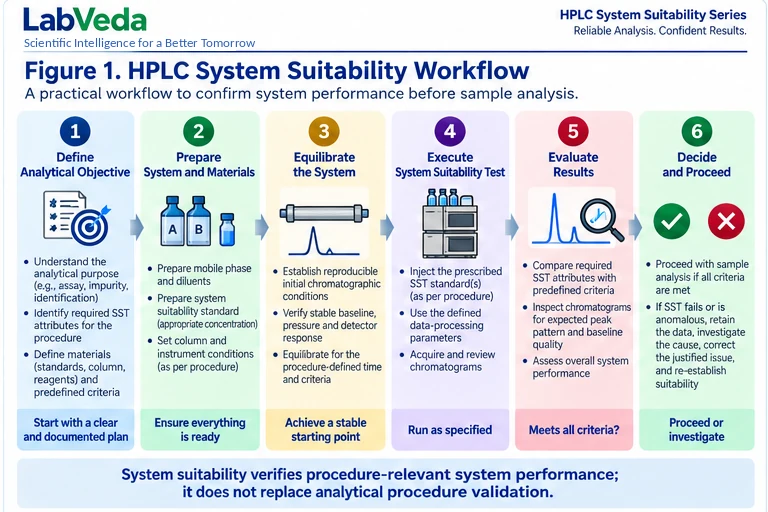
A six-step HPLC system suitability workflow: define the analytical objective and criteria, prepare the system and materials, equilibrate to reproducible conditions, execute the suitability injections, evaluate every attribute against its predefined criterion, and decide whether to proceed or investigate.

HPLC System Suitability: Parameters, Interpretation and Troubleshooting

HPLC system suitability testing (SST) is a predefined check that verifies the chromatographic measurement system and the analytical operations of a procedure are adequate for the intended analysis before results are reported. It is not a generic instrument-health score and not a substitute for analytical procedure validation; the right parameters and acceptance criteria depend on …

HPLC System Suitability: Parameters, Interpretation and Troubleshooting Read More »

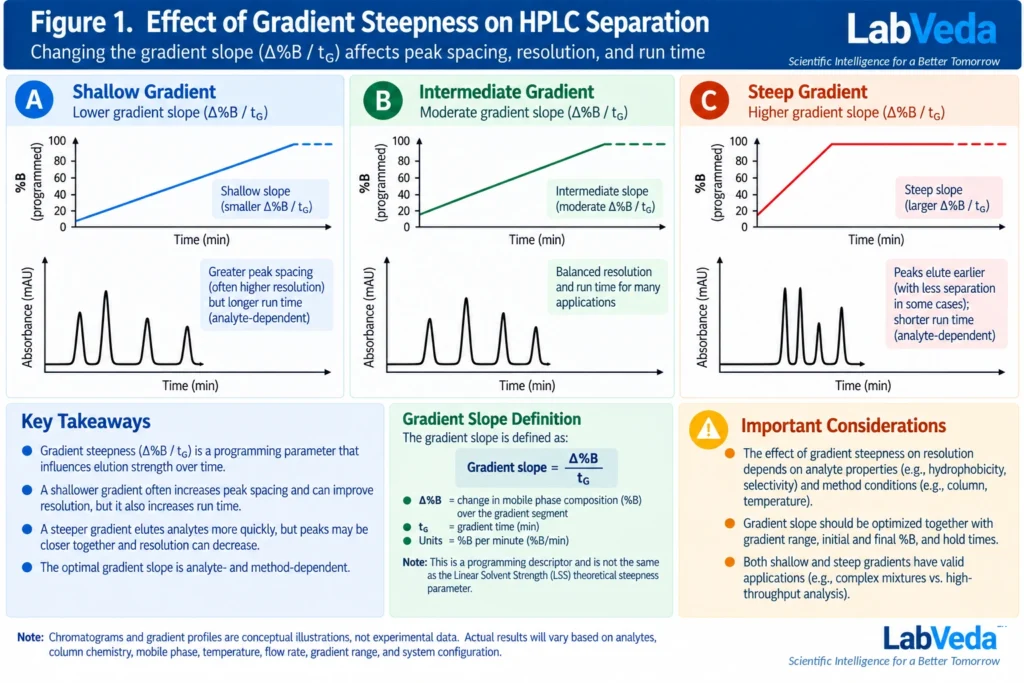
Three conceptual HPLC gradient profiles and their chromatograms comparing a shallow, intermediate and steep gradient slope, showing wider peak spacing and longer run time for the shallow gradient and earlier, more compressed peaks for the steep gradient.

Gradient Optimization in HPLC: Steepness, Selectivity, Resolution, and Run Time

Gradient optimization in HPLC is the systematic adjustment of a solvent program — its steepness, range, shape, gradient time, wash and re-equilibration — to obtain adequate resolution of the critical pairs in acceptable run time, with good peak shape and reproducible retention. It balances separation quality against throughput rather than simply making peaks elute faster. …

Gradient Optimization in HPLC: Steepness, Selectivity, Resolution, and Run Time Read More »

LOD Calculation: How to Determine the Limit of Detection Using ICH Q2 Methods

The limit of detection is calculated as LOD = 3.3σ/S, where σ is the standard deviation of the response and S is the slope of the calibration curve. ICH Q2(R2) permits σ to be estimated from replicate blank measurements1, from the residual standard deviation of a regression line, or from the standard deviation of y-intercepts …

LOD Calculation: How to Determine the Limit of Detection Using ICH Q2 Methods Read More »

Limit of Detection (LOD): What It Means and How It Differs from LOQ

The limit of detection is the lowest analyte concentration that a procedure can reliably distinguish from a blank, but not necessarily measure with acceptable accuracy. It is a property of the whole procedure — instrument, matrix, preparation and operator — not of the instrument alone. ICH Q2(R2) expresses it as LOD = 3.3σ/S. Most disputes about detection …

Limit of Detection (LOD): What It Means and How It Differs from LOQ Read More »

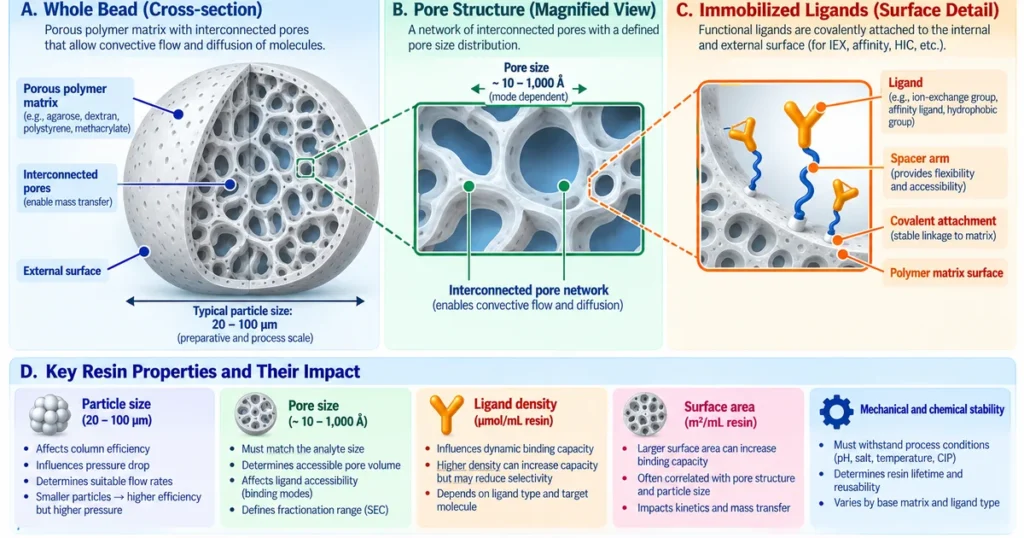
Anatomy of a chromatography resin bead: a cutaway of the porous polymer matrix and its interconnected pore network, the pore structure magnified, immobilized ligands attached to the pore wall through a spacer arm, and the resin specifications of particle size, pore size, ligand density, surface area and stability

Chromatography Resins: Types, Properties and How to Select the Right Resin

A chromatography resin is the particulate stationary phase packed into a chromatographic bed: a base matrix, a defined particle size, an internal pore architecture and — in most binding modes — an immobilized functional ligand. Which of those four dominates depends on the separation mechanism the step is built on, not on which polymer the …

Chromatography Resins: Types, Properties and How to Select the Right Resin Read More »

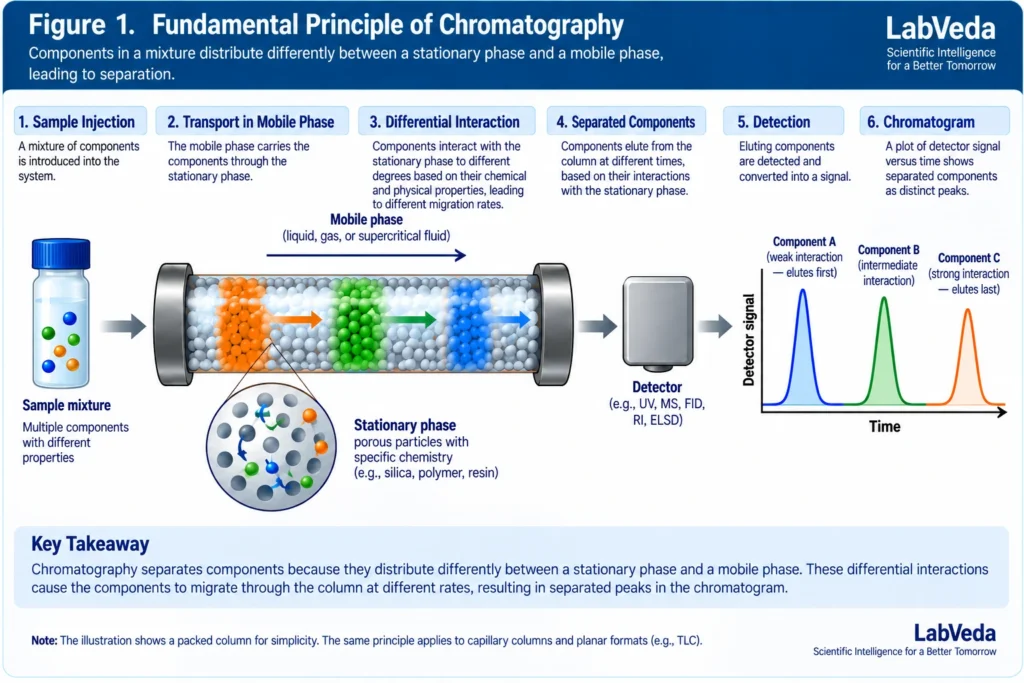
Five-step diagram of the chromatographic separation process: a sample mixture is injected, the mobile phase carries it through a packed column, components interact differently with the stationary phase, a detector records the eluting components, and separated peaks A, B and C appear on a chromatogram.

What Is Chromatography? Principles, Types, Separation Mechanisms, and Applications

Chromatography is a physical separation method in which the components of a mixture distribute differently between a stationary phase and a mobile phase that moves in a defined direction.1 Because different components interact with the two phases to different extents, they migrate at different rates and emerge as separated zones, or peaks. The mobile phase …

What Is Chromatography? Principles, Types, Separation Mechanisms, and Applications Read More »

Scroll to Top