
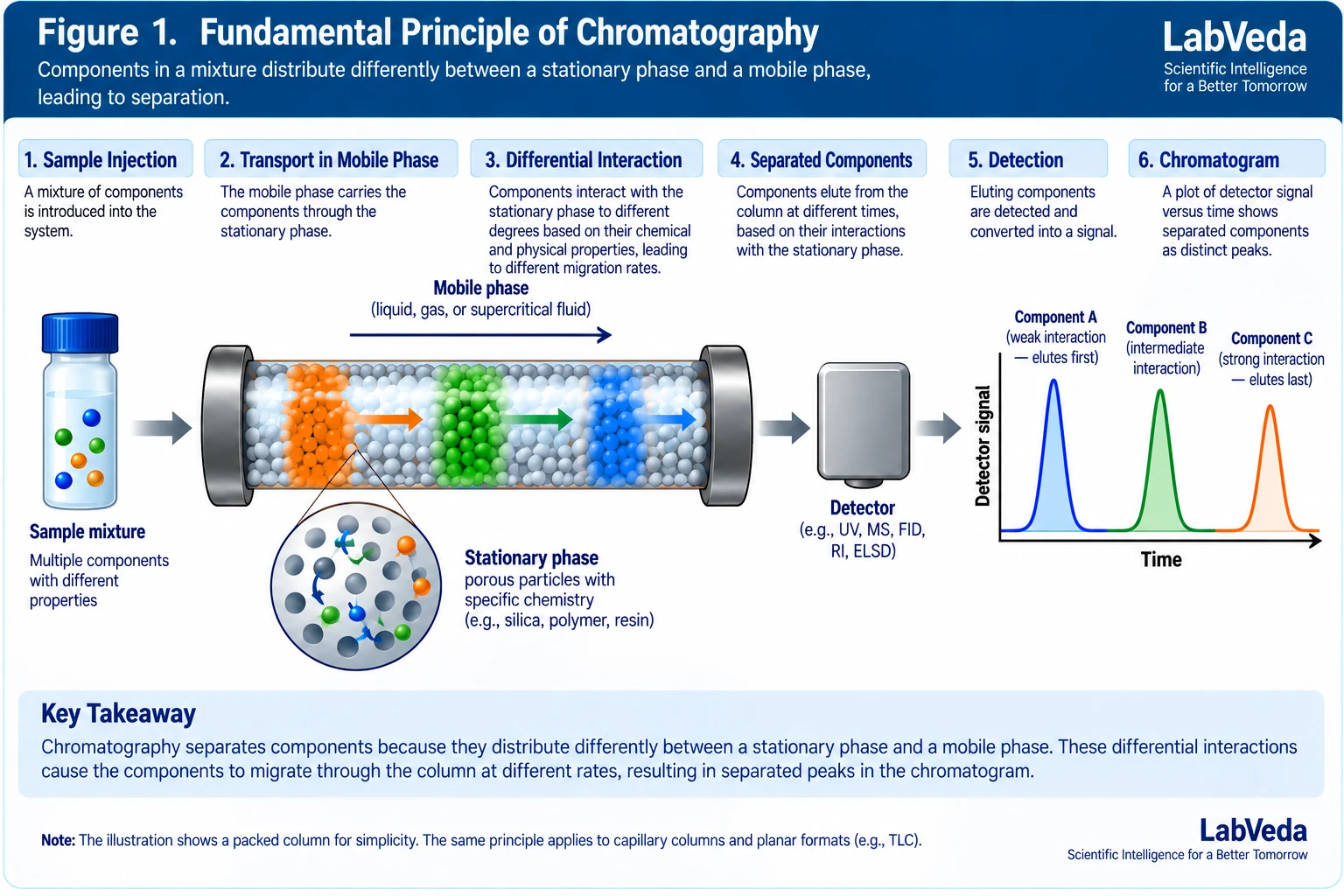
Chromatography is a physical separation method in which the components of a mixture distribute differently between a stationary phase and a mobile phase that moves in a defined direction.1 Because different components interact with the two phases to different extents, they migrate at different rates and emerge as separated zones, or peaks.
The mobile phase may be a liquid, a gas, or a supercritical fluid, and the stationary phase may be a solid, a gel, a liquid supported on a solid, a chemically bonded phase, or an immobilized phase appropriate to the technique.2,3 This definition is deliberately broader than HPLC or GC: chromatography is a family of separation methods. HPLC, GC, supercritical fluid chromatography (SFC), thin-layer chromatography (TLC), ion-exchange chromatography (IEX), size-exclusion chromatography (SEC), affinity chromatography, and hydrophobic-interaction chromatography (HIC) describe different combinations of physical format, mobile phase, stationary phase, and separation mechanism.1,4
How does chromatography work?
Figure 1 summarizes the general process. A sample is introduced into the chromatographic system; the mobile phase transports its components through or along the stationary phase; repeated differences in distribution, adsorption, charge interaction, steric accessibility, or specific binding produce different migration rates; and the separated components are visualized directly or detected as a chromatogram.1,5
What are the stationary phase and the mobile phase?
The stationary phase is one of the two phases that form the chromatographic system. Depending on the method, it may be a solid, a gel, a liquid supported on a solid, a chemically bonded phase, or an immobilized phase.3 The mobile phase is the fluid that moves through or along the stationary bed; IUPAC recognizes liquid, gaseous, and supercritical-fluid mobile phases.2
The word ‘stationary’ does not mean chemically inert. In many separations the stationary phase is deliberately engineered to create selective interactions with analytes. The mobile phase, likewise, does more than transport the sample: its composition, pH, ionic strength, temperature, pressure, or solvent strength can all alter retention and selectivity.
How is chromatography classified?
A common source of confusion is placing HPLC, ion exchange, SEC, LC–MS, and preparative chromatography in a single flat list. These labels describe different dimensions of a method. Figure 2 separates three useful classification axes — physical format and mobile phase, separation mechanism, and analytical implementation — and Table 1 lists the major formats by mobile phase. A real method combines these dimensions: reversed-phase HPLC–MS, for example, is liquid column chromatography that uses a predominantly partition-related retention mode with mass-spectrometric detection.
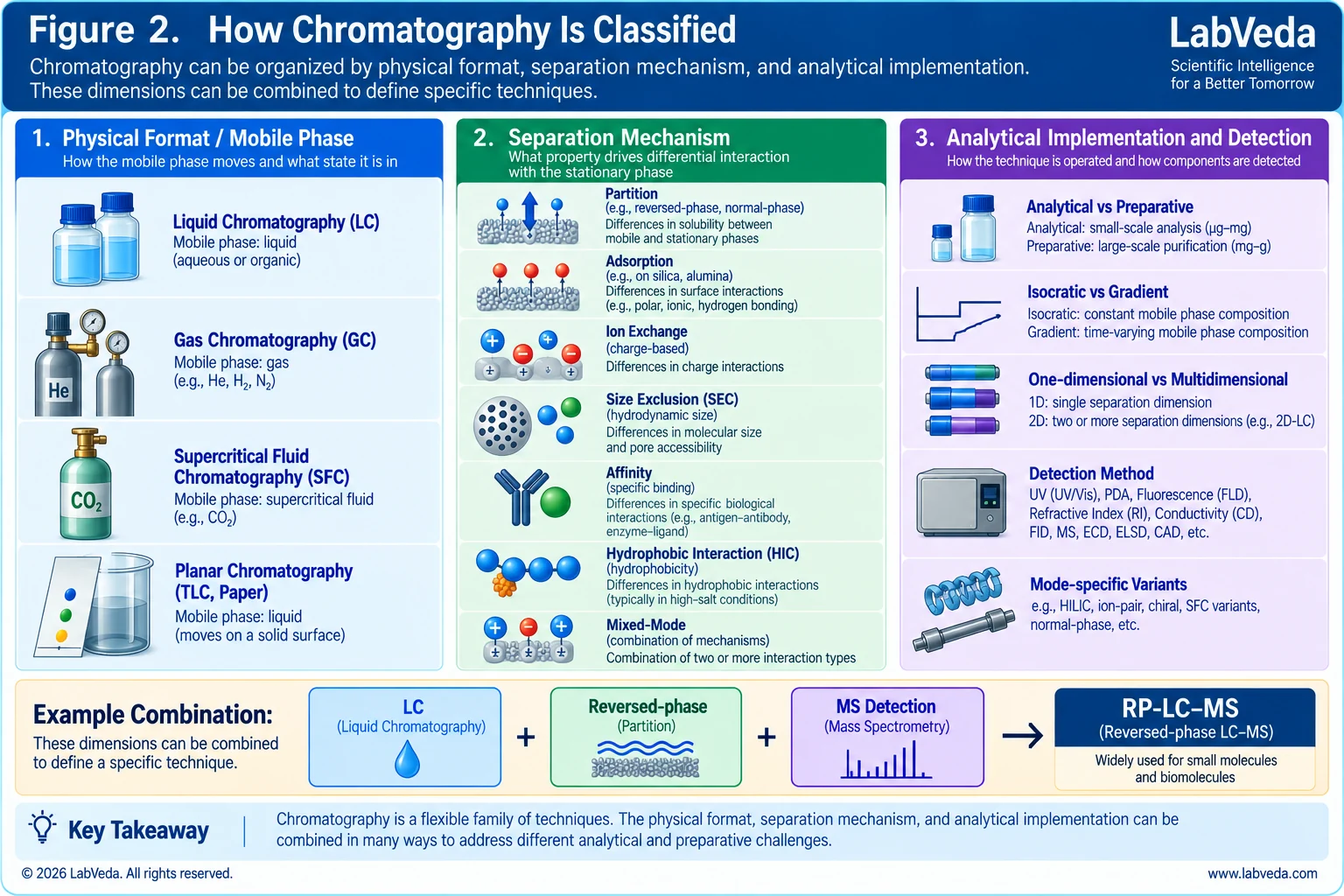
| Format | Mobile phase | Stationary-phase format | Typical scope | Practical strength |
|---|---|---|---|---|
| Liquid chromatography (LC / HPLC / UHPLC) | Liquid | Packed or monolithic column; many stationary-phase chemistries | Small molecules, ions, biomolecules, polymers | Broad chemical scope; many detector choices |
| Gas chromatography (GC) | Gas (carrier gas) | Open-tubular or packed column | Volatile and sufficiently thermally stable compounds | High efficiency; powerful temperature programming |
| Supercritical fluid chromatography (SFC) | Supercritical fluid, commonly CO2 with a modifier | Packed column | Small molecules, chiral separations, lipophilic to moderately polar analytes | Fast separations; complementary selectivity |
| Planar chromatography (TLC / HPTLC) | Liquid mobile phase moving across a planar stationary phase | Thin sorbent layer | Small molecules; screening and qualitative or semiquantitative workflows | Simple; parallel samples; visual inspection |
What are the major separation mechanisms?
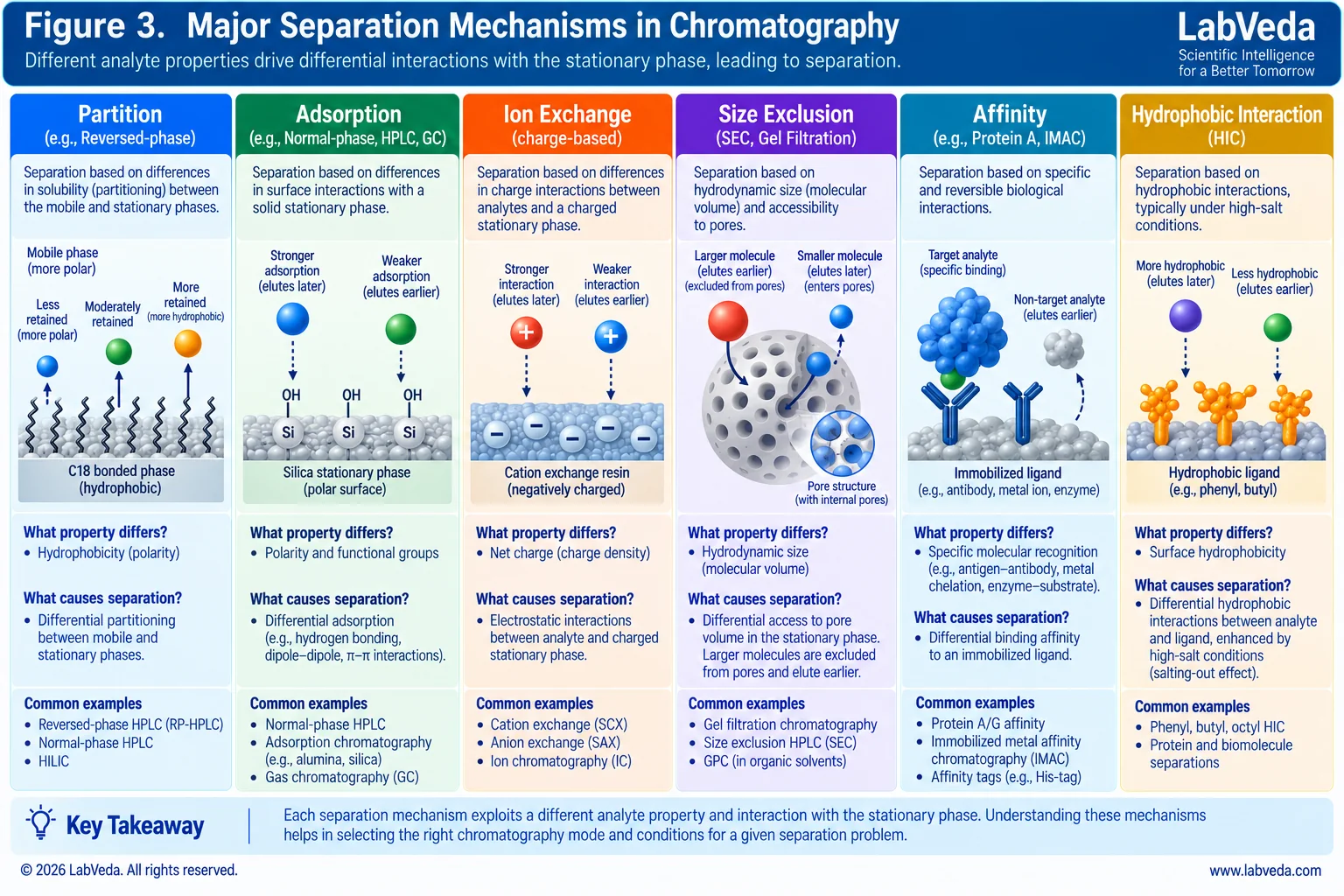
The separation mechanism describes why two analytes are retained differently. In practice, some modes are governed predominantly by one interaction while others are multimodal. Figure 3 illustrates six important mechanisms, and Table 2 compares their principal control variables.
| Mode | Primary separation basis | Typical analytes | Key controls | Important limitation |
|---|---|---|---|---|
| Reversed-phase LC | Predominantly hydrophobic, partition-related interactions | Small molecules, peptides | Organic fraction, stationary-phase chemistry, pH, temperature | Very polar analytes may show weak retention |
| Normal-phase / adsorption LC | Differential adsorption and solvent competition | Nonpolar to moderately polar compounds; isomers | Stationary-phase activity, solvent strength, water content | Sensitive to moisture and surface activity |
| HILIC | Multimodal retention, with partitioning plus other interactions | Polar and ionic analytes | Water fraction, organic solvent, pH, ionic strength | Equilibration and selectivity can be sensitive |
| Ion exchange (IEX) | Differences in ion-exchange affinity | Ions, proteins, biomolecules | pH, ionic strength, exchanger chemistry | Strong dependence on analyte charge state |
| Size exclusion (SEC) | Hydrodynamic volume and pore accessibility in non-adsorbing porous media | Proteins, polymers, nanoparticles | Pore architecture, flow, sample volume | Limited resolution for species of similar hydrodynamic size |
| Affinity | Specific recognition and binding | Proteins and other targets with suitable ligand chemistry | Ligand, binding and elution conditions | Ligand cost, capacity, target dependence |
| Hydrophobic interaction (HIC) | Hydrophobic interactions under suitable solution conditions | Proteins | Salt type and concentration, ligand hydrophobicity, pH | Method development is protein- and condition-dependent |
How do partition, adsorption, ion exchange, SEC, affinity and HIC differ?
In partition chromatography, separation is based mainly on differences in solubility and distribution between the stationary and mobile phases.6 Ion-exchange chromatography is based mainly on differences in ion-exchange affinity, governed by analyte charge state and the exchanger chemistry.7 Size-exclusion chromatography should not be described simply as ‘smaller molecules are retained more.’ IUPAC defines SEC by separation according mainly to hydrodynamic volume in a porous, non-adsorbing material; pore accessibility determines the volume available to a molecule and therefore its migration behavior.8
Affinity chromatography uses deliberately specific recognition interactions, whereas HIC exploits differences in accessible hydrophobic character under solution conditions that promote useful differential interaction. These mechanisms can be implemented in conventional columns, monoliths, membranes, or other chromatographic architectures, depending on the application.
How do HPLC, GC, SFC and planar chromatography compare?
HPLC is not a single separation mechanism. It is a high-performance liquid chromatographic implementation that can use reversed-phase, normal-phase, HILIC, ion-exchange, size-exclusion, affinity, mixed-mode, and other stationary phases. GC instead uses a gaseous mobile phase and is especially valuable when analytes have sufficient volatility and thermal stability for the method. SFC uses a supercritical-fluid mobile phase and occupies a complementary selectivity space. TLC and HPTLC perform the separation on a planar stationary phase rather than within a conventional column.1,2,4
What does a chromatogram show?
A chromatogram is the recorded detector response — or another measure of separated zones — as a function of time, volume, distance, or another appropriate migration coordinate. In column chromatography, retention time identifies when a component reaches the detector under specified conditions, and peak area or height can support quantitation when the detector response and calibration model are appropriate. Table 3 defines the core quantities used to describe retention, efficiency, and separation.
| Quantity | What it describes | Interpretive caution |
|---|---|---|
| Retention time, tR | Observed time from injection (or a reference point) to a peak | Useful for identification only under controlled method conditions |
| Hold-up time, tM | Time for an unretained mobile-phase marker to pass through the column | Needed for adjusted retention and retention-factor calculations |
| Retention factor, k | Adjusted retention relative to the hold-up time | Measures chromatographic retention independent of simple elapsed time |
| Separation factor, α | Relative retention of two adjacent peaks; by definition > 1 | Measures relative retention (selectivity) between the pair |
| Plate number, N / HETP | Efficiency metrics derived from retention and peak width under stated conventions | Describe band broadening and column performance; the calculation convention matters |
| Resolution, Rs | Degree of separation between two peaks | Integrates retention, relative retention, and efficiency effects |
What are retention, selectivity, efficiency and resolution?
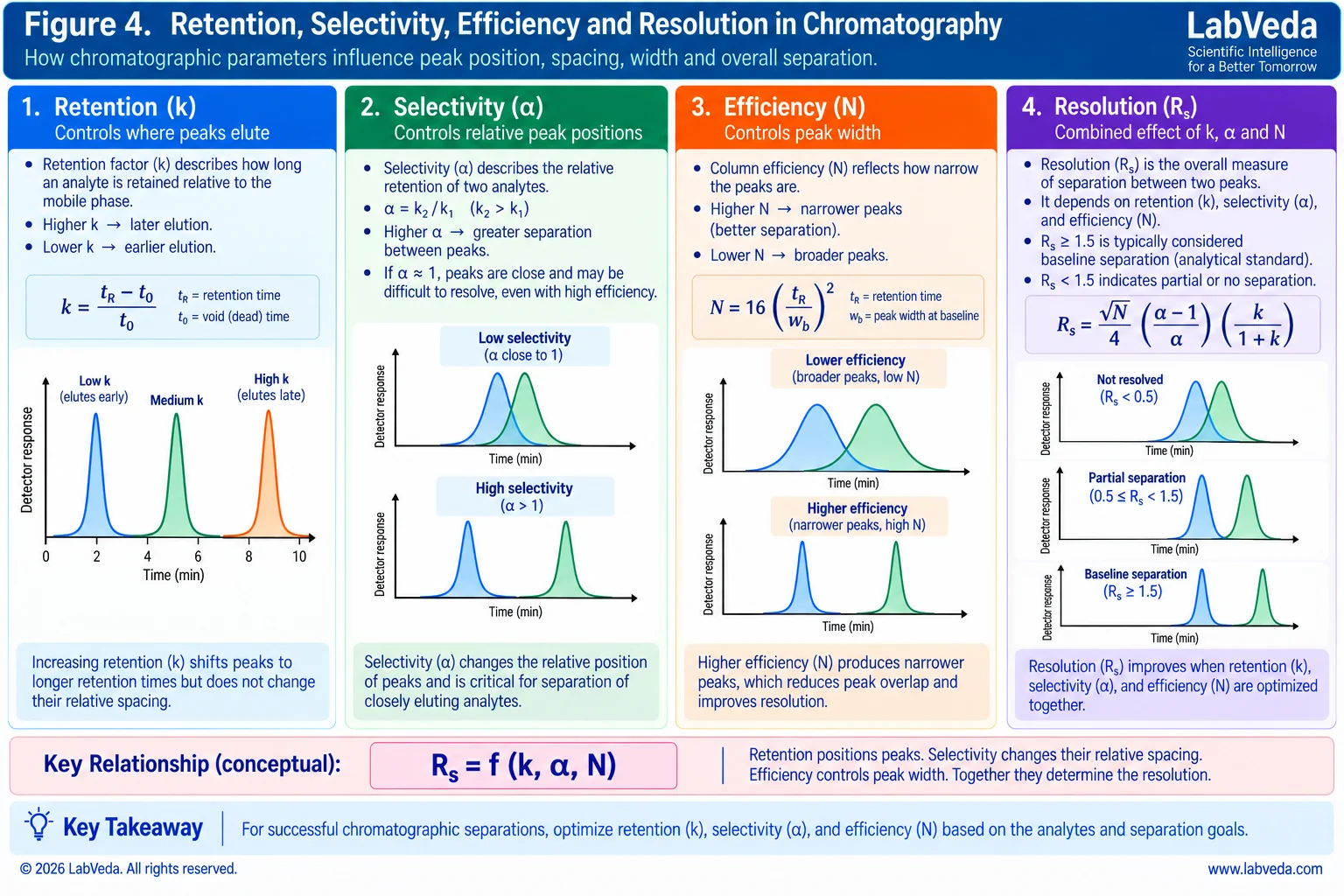
Good chromatography requires more than making analytes stay on a column. The retention factor (k) describes how strongly an analyte is retarded relative to mobile-phase migration.9 The separation factor (α) compares the relative retention of two adjacent peaks and is defined so that α is greater than one.10 Column efficiency is commonly expressed through the plate number (N) or plate height (HETP), while resolution (Rs) quantifies how well two peaks are separated.5
Figure 4 shows the familiar approximate resolution relationship used to illustrate the leverage of efficiency, separation factor, and retention. It should be treated as a conceptual method-development framework rather than a universal predictive equation for every chromatographic system: in real methods, changing mobile phase, temperature, stationary phase, flow, or gradient conditions can affect several terms at once.
How do you choose a chromatography technique?
Technique selection should begin with the analytical question and the analyte properties, not with instrument availability alone. Table 4 provides a first-pass decision framework. The final method choice also depends on matrix, required sensitivity, throughput, sample amount, detector compatibility, recovery, regulatory context, and whether the objective is analysis or purification.
| Analytical problem | Technique(s) to consider | Why |
|---|---|---|
| Volatile, thermally suitable small molecules | GC | Excellent efficiency and mature detector and MS options |
| Broad small-molecule pharmaceutical analysis | Reversed-phase HPLC / UHPLC | Broad applicability and robust quantitative workflows |
| Very polar analytes poorly retained by RP-LC | HILIC, ion chromatography, mixed-mode, or a derivatization strategy | Choose on the basis of ionization and detector compatibility |
| Inorganic or organic ions | Ion chromatography / IEX | Charge-based selectivity with conductivity or spectroscopic detection |
| Protein aggregate or size-variant assessment | SEC | Separation by hydrodynamic volume under low-adsorption conditions |
| Protein capture with a known binding handle | Affinity chromatography | High biological or chemical recognition selectivity |
| Protein polishing based on charge | IEX | Strong selectivity tunable by pH and ionic strength |
| Protein separation based on accessible hydrophobicity | HIC | Selectivity orthogonal to IEX and SEC under appropriate salt conditions |
| Rapid visual screening or many samples in parallel | TLC / HPTLC | Simple planar workflow and parallel development |
| Chiral or complementary small-molecule selectivity | SFC or chiral LC | Technique choice depends on analyte, stationary phase, and detection |
AI Method Builder
Draft a starting method for your separation and refine it — save your work to your account.
What is the difference between analytical and preparative chromatography?
Analytical chromatography is optimized primarily to identify, characterize, or quantify components using relatively small sample amounts. Preparative chromatography is optimized to isolate useful quantities of purified material. The governing chromatographic principles remain related, but loading, column dimensions, flow, recovery, fraction collection, productivity, solvent consumption, and economics become far more important as scale increases.
What are isocratic, gradient, temperature-programmed and multidimensional separations?
In isocratic LC the mobile-phase composition stays constant during the separation; in gradient LC it changes with time. GC commonly uses temperature programming to change analyte volatility and retention behavior during a run. Multidimensional methods couple separations with different selectivities — for example LC×LC or GC×GC — while hyphenated systems such as LC–MS and GC–MS combine chromatography with a detector that adds chemical information.
Why does chromatography fail?
Poor separation can arise from inadequate retention, an insufficient separation factor, excessive band broadening, overload, poor sample-solvent compatibility, column contamination, incorrect flow, temperature instability, leaks, detector limitations, or unsuitable chemistry. The most useful troubleshooting question is therefore not ‘Which part is bad?’ but ‘Which mechanism can explain the complete symptom pattern?’ Table 5 connects common observations to the first scientific variable to investigate.
| Observed problem | Primary variable family | First diagnostic direction |
|---|---|---|
| Peaks coelute | Insufficient relative retention (selectivity) | Change chemistry, pH, solvent, temperature, gradient, or stationary phase as appropriate |
| Peaks are broad | Band broadening, low efficiency, or extra-column contribution | Check flow, column condition, fittings, injection volume, and system dispersion |
| Retention shifts | Flow, composition, temperature, equilibration, or chemistry | Classify the drift pattern and verify the actual operating conditions |
| Tailing | Surface activity, overload, dead volume, or chemistry mismatch | Determine whether all peaks or only active analytes tail |
| Fronting | Overload or an injection / focusing problem | Reduce mass or volume and review the injection conditions |
| High background or ghost peaks | Contamination, carryover, mobile phase or gas, column bleed, or detector | Use blanks and isolate subsystems |
What is chromatography used for?
Chromatography supports identification, purity assessment, quantitative analysis, impurity profiling, biomolecule characterization, environmental and food analysis, forensic workflows, process development, and preparative purification. The appropriate technique depends on the chemical problem: a volatile organic contaminant, an inorganic anion, a pharmaceutical impurity, a monoclonal-antibody aggregate, and a chiral small molecule do not belong to one universal chromatographic workflow.11
Frequently asked questions
What is the simplest definition of chromatography?
It is a physical separation method in which the components of a mixture distribute differently between a stationary phase and a mobile phase that moves in a defined direction, so the components migrate at different rates and separate.
Is HPLC the same as chromatography?
No. HPLC is one implementation of liquid chromatography. Chromatography also includes GC, SFC, TLC, ion exchange, SEC, affinity, and many other formats and mechanisms.
What are the stationary and mobile phases?
The stationary phase remains fixed in the chromatographic bed or planar layer, while the mobile phase moves through or along it. The mobile phase can be a liquid, a gas, or a supercritical fluid.
Why do compounds separate in chromatography?
They experience different effective interactions with, or different access to, the stationary and mobile phases, which produces different migration rates and therefore different retention.
What determines chromatographic resolution?
Resolution depends on the relative positions and the widths of two peaks. Retention, the separation factor (selectivity), and efficiency are the major contributors.
Which chromatography technique is best?
There is no universal best technique. Selection depends on analyte properties, matrix, analytical objective, scale, detector requirements, and the performance the method must reach.
The takeaway
Chromatography is not a single instrument but a family of separation methods that all rest on one idea: components of a mixture distribute differently between a moving phase and a fixed one, so they migrate at different rates and separate. Describing a method well means stating its physical format and mobile phase, its dominant separation mechanism, and its analytical implementation, because these are independent choices that combine into a real technique. Once a separation exists, retention, selectivity, efficiency, and resolution are the quantities that describe how good it is and point to what to change when it is not good enough.
Working through a real separation? A free LabVeda account saves your diagnostics, method-development sessions and exports and carries them across visits — the Knowledge Hub and tools stay open to everyone.
References
- International Union of Pure and Applied Chemistry (IUPAC). “Chromatography”, Compendium of Chemical Terminology (the Gold Book), online version 5.0.0 (2025). DOI: 10.1351/goldbook.C01075.
- IUPAC. “Mobile phase in chromatography”, Gold Book. DOI: 10.1351/goldbook.M03952.
- IUPAC. “Stationary phase in chromatography”, Gold Book. DOI: 10.1351/goldbook.S05949.
- United States Pharmacopeia. General Chapter ⟨621⟩ Chromatography, USP–NF (current online chapter, accessed 2026).
- L. S. Ettre, “Nomenclature for chromatography (IUPAC Recommendations 1993)”, Pure and Applied Chemistry 65(4), 819–872 (1993). DOI: 10.1351/pac199365040819.
- IUPAC. “Partition chromatography”, Gold Book. DOI: 10.1351/goldbook.P04436.
- IUPAC. “Ion-exchange chromatography”, Gold Book. DOI: 10.1351/goldbook.I03168.
- IUPAC. “Size-exclusion chromatography”, Gold Book. DOI: 10.1351/goldbook.S05705.
- IUPAC. “Retention factor in column chromatography”, Gold Book. DOI: 10.1351/goldbook.R05359.
- IUPAC. “Separation factor in column chromatography”, Gold Book. DOI: 10.1351/goldbook.S05614.
- L. C. Sander, “What is Chromatography All About?”, Journal of Research of the National Institute of Standards and Technology 122, Article 12 (2017). DOI: 10.6028/jres.122.012.
Further reading
- L. R. Snyder, J. J. Kirkland and J. W. Dolan, Introduction to Modern Liquid Chromatography, 3rd ed., Wiley (2010).
- C. F. Poole, The Essence of Chromatography, Elsevier (2003).
- H. M. McNair, J. M. Miller and N. H. Snow, Basic Gas Chromatography, 3rd ed., Wiley (2019).
Reviewed against primary sources. Every definition, term, and relationship on this page is checked against the IUPAC Compendium of Chemical Terminology (Gold Book), the IUPAC 1993 chromatography nomenclature recommendations, and USP General Chapter ⟨621⟩. The resolution relationship shown in Figure 4 is an illustrative conceptual framework, not a method-development prediction or an acceptance criterion. For validated or compendial methods, the applicable procedure and regulatory framework take precedence over the general rules of thumb given here. Evidence review: September 2026.