
The Knowledge Hub
Practical troubleshooting guides for working analytical chemists — HPLC, UHPLC, LC-MS, GC, and reagent prep. Each guide is diagnostic-first and linked to the tool that resolves it.
Understanding RF Values in Chromatography Techniques
The retardation factor, RF, is the migration coordinate used in planar chromatography. In TLC, HPTLC and paper chromatography it expresses how far…
How to Develop an HPLC Method: A Step-by-Step Practical Guide
Introduction Developing an HPLC method is one of the most fundamental skills in analytical chemistry. Whether working in pharmaceutical analysis, bioanalysis, environmental…
What is Void Volume in Chromatography?
Void volume (V0) is the volume of mobile phase inside the column — the space between and within the packing particles that…
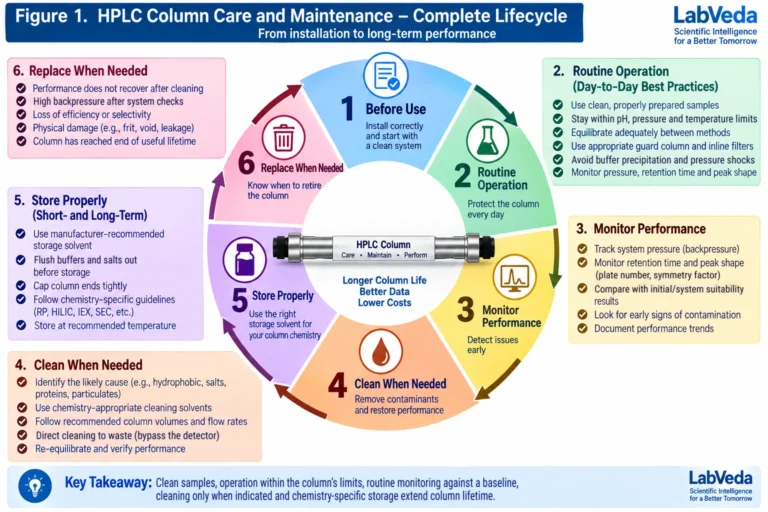
HPLC Column Care and Maintenance: How to Protect, Monitor and Store a Column
HPLC column care is the set of preventive practices that keep the packed bed, the inlet frit and the stationary phase in…
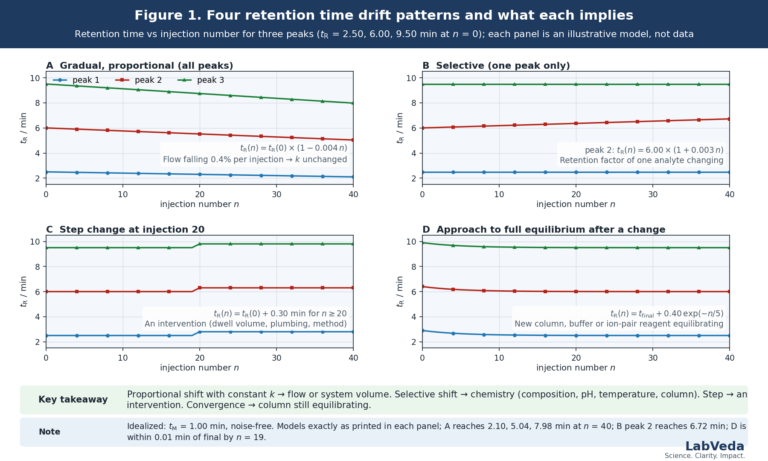
Drifting HPLC Retention Times: Causes, Diagnosis and Fixes
Drifting HPLC retention times are diagnosed by their pattern. Because tR = tM(1 + k), a shift that moves every peak by…
Chromatography Terms
HPLC Column Cleaning
As HPLC chemists we know that columns do have a finite lifetime. You column life time (total number of samples you can…
HPLC Peak Shape Problems: Tailing, Fronting, Splitting and Broadening
Splitting, fronting, tailing or broadening? Identify the peak shape first, then work the likely causes in order. A practical HPLC diagnostic guide…