HPLC LC/MS Troubleshooting

Chromatography troubleshooting is a key part of a chromatographer’s daily work. Here, we present articles and protocols to help a chromatorgher achieve this efficiently.

How to Develop an HPLC Method: A Step-by-Step Practical Guide

Introduction Developing an HPLC method is one of the most fundamental skills in analytical chemistry. Whether working in pharmaceutical analysis, bioanalysis, environmental testing, or QC laboratories, a structured approach to method development saves time, improves reproducibility, and strengthens regulatory defensibility. Yet many scientists still rely on trial-and-error adjustments instead of systematic strategy. This guide outlines …

How to Develop an HPLC Method: A Step-by-Step Practical Guide Read More »
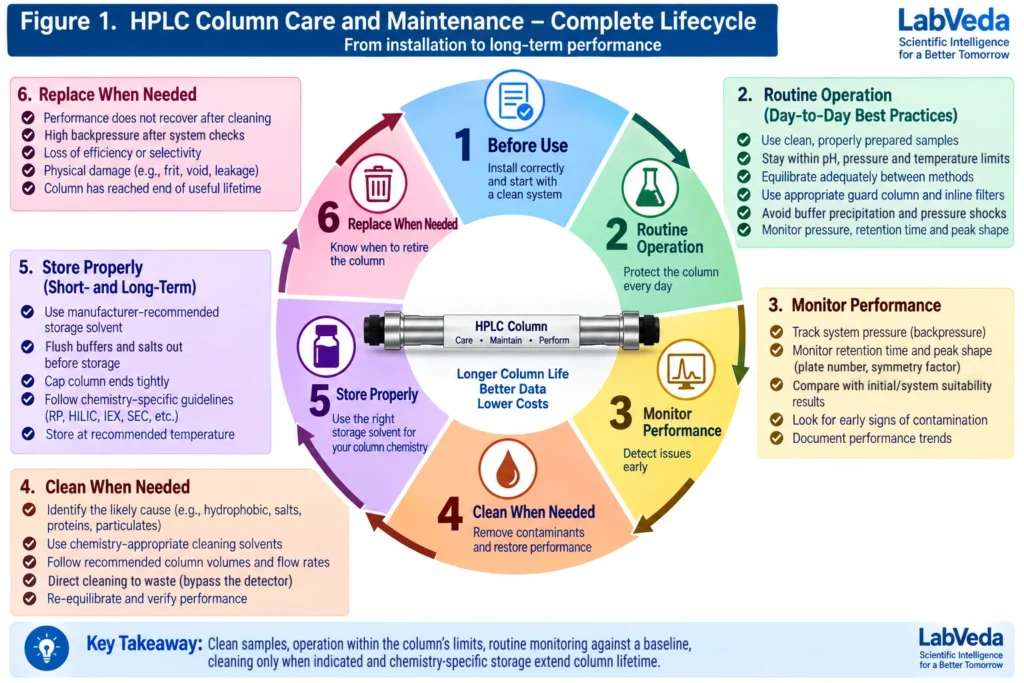
Circular six-stage diagram of HPLC column care and maintenance: before use, routine operation, monitor performance, clean when needed, store properly and replace when needed, with a checklist of actions beside stages 2 to 6 and an HPLC column at the center.

HPLC Column Care and Maintenance: How to Protect, Monitor and Store a Column

HPLC column care is the set of preventive practices that keep the packed bed, the inlet frit and the stationary phase in the state that produced the method’s original chromatography: clean samples and mobile phases, operation inside the column’s pH, pressure and temperature limits, evidence-based equilibration, trended performance monitoring, cleaning only when indicated and chemistry-specific …

HPLC Column Care and Maintenance: How to Protect, Monitor and Store a Column Read More »

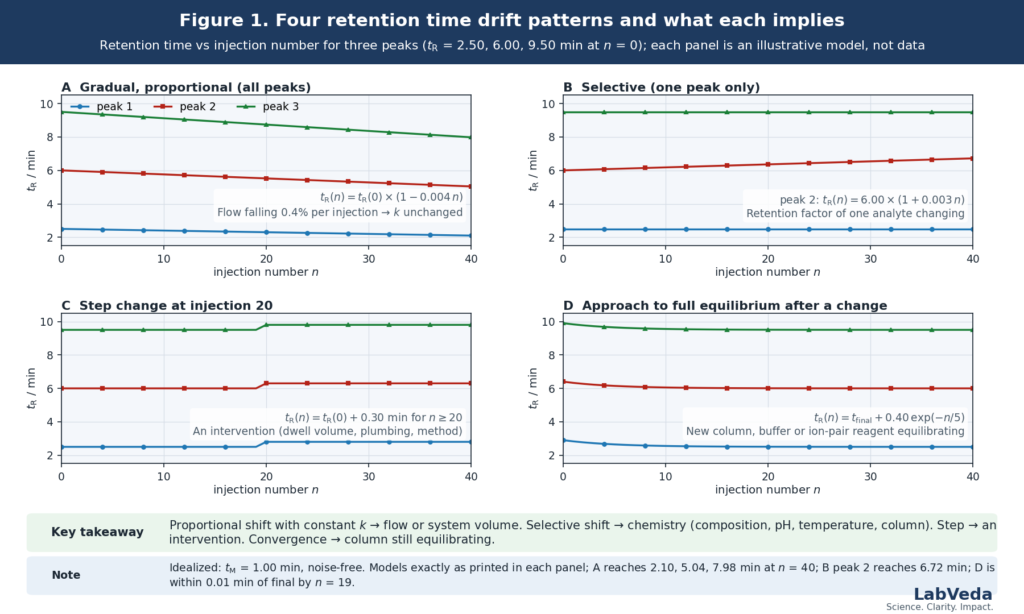
Four panels of HPLC retention time versus injection number for three peaks over 40 injections showing gradual proportional drift from a falling flow rate, selective drift of one peak from a retention factor change, a step change of 0.30 minutes in all peaks at injection 20 and run-to-run convergence as a column approaches full equilibrium after a change of column or mobile phase

Drifting HPLC Retention Times: Causes, Diagnosis and Fixes

Drifting HPLC retention times are diagnosed by their pattern. Because tR = tM(1 + k), a shift that moves every peak by the same proportion means the hold-up time or the flow has changed, while a shift confined to some peaks means their retention factors have changed: chemistry, not flow or volume. Gradual, step, erratic, …

Drifting HPLC Retention Times: Causes, Diagnosis and Fixes Read More »

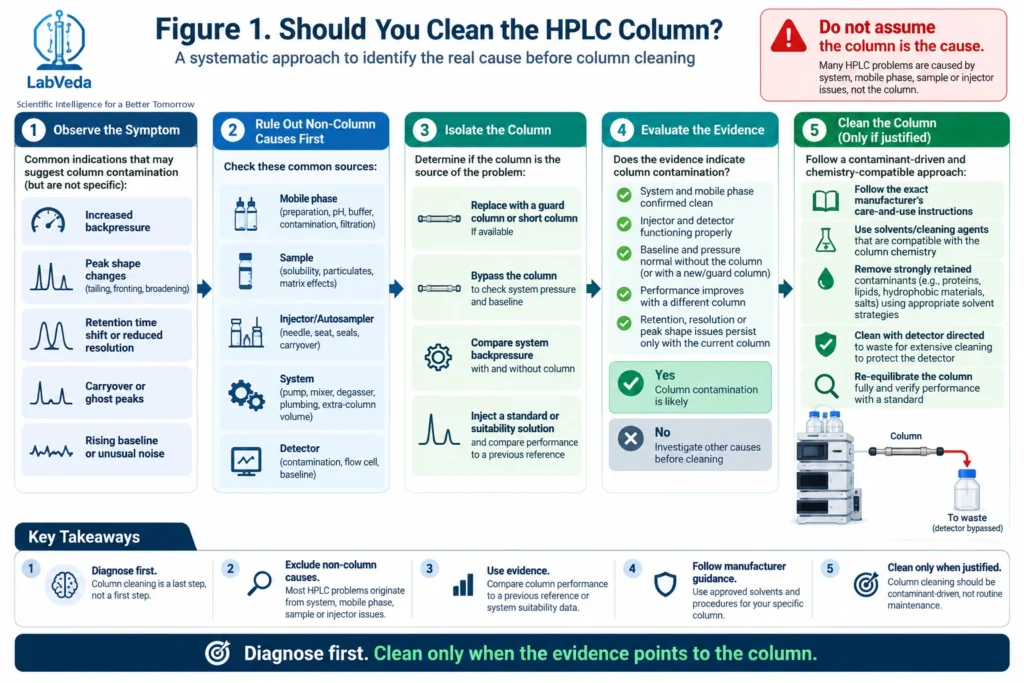
Diagnostic-first workflow for deciding whether to clean an HPLC column: observe the symptom, rule out non-column causes, isolate the column, evaluate the evidence, and clean only if justified

HPLC Column Cleaning: How to Diagnose Contamination, Clean Safely, and Verify Recovery

Do not clean an HPLC column simply because pressure, retention or peak shape changed. First rule out the system, mobile phase, sample, injector, detector and guard column. If the evidence points to the analytical column, choose a cleaning procedure based on the likely contaminant, the stationary-phase chemistry, solvent compatibility and the manufacturer’s current care-and-use instructions. …

HPLC Column Cleaning: How to Diagnose Contamination, Clean Safely, and Verify Recovery Read More »

Scroll to Top